
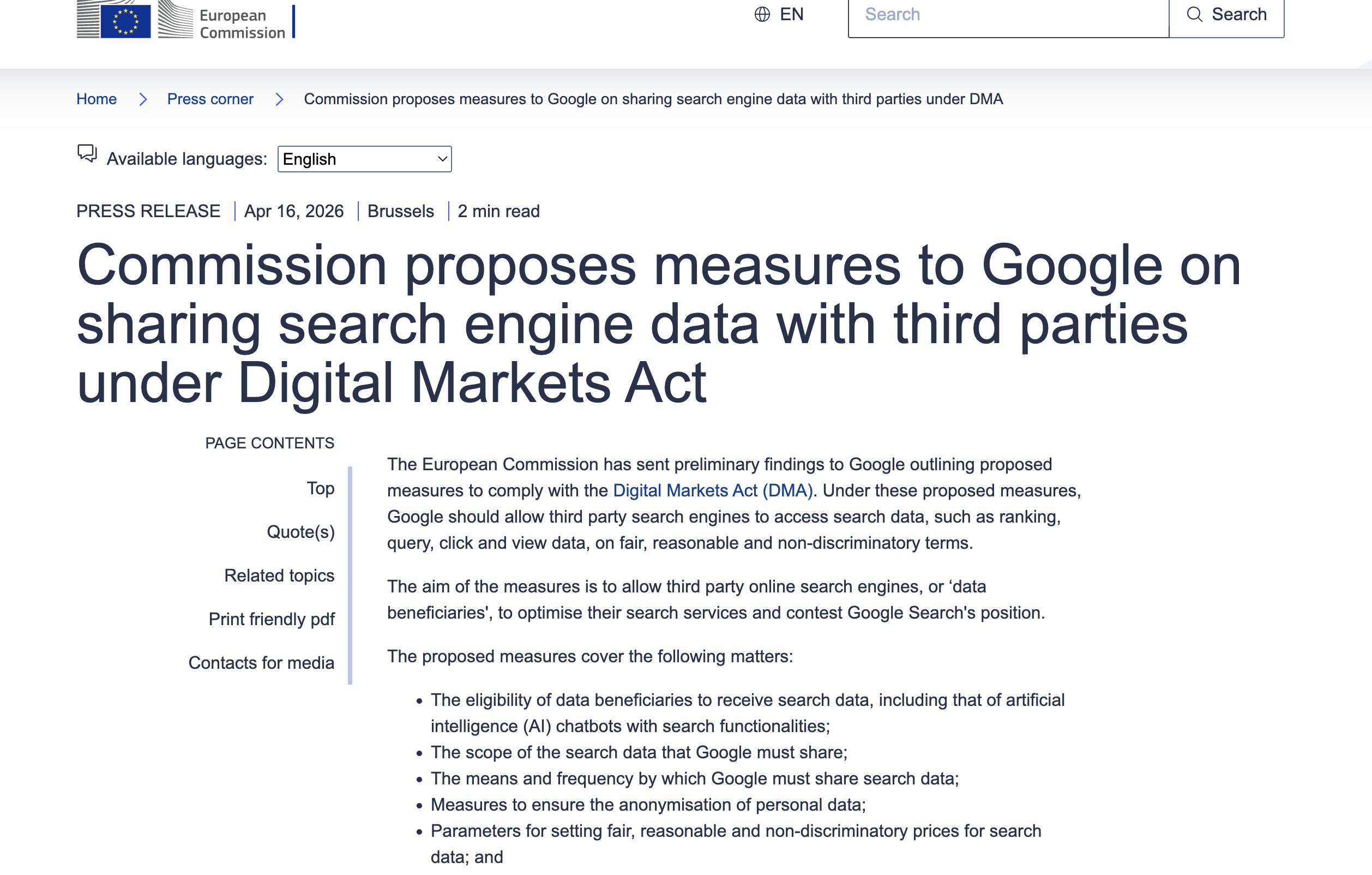
I work with Google everyday. That's why the new proposed measures worries me. The EU is forcing Google to share its search data with competitors by 27 July 2026. It's being framed as a win for the market. I'm not so sure. In this piece, I'll try to explain myself.
I work in advertising and SEO. Every day, at 6th Man, this is what we do. That's why the new Google proposed measures worries me.
The EU plans to rule that Google must share its search data with competitors. By 27 July 2026. Ranking, query, clicks and view data. All of it, handed to what the legislation calls "qualified competitors."
The news is being framed as a win for the market. And it is. I think? Twenty years of a Google monopoly is finally facing pushback. As a founder, as a marketer, as someone who believes no single company should own 90% of the search market forever, I should be cheering.
But that's not quite what I'm feeling.
I've worked in online advertising for years. I built 6th Man on Google traffic. I tell clients every week how to be found better. I'm in Google Ads, Meta Ads, GA4 and Search Console every single day. And that's exactly why this potential ruling worries me. Not because it hurts Google. Because nobody's talking about what's actually being shared.
What advertisers see
If you've never been inside the back end of an advertising platform, it's hard to describe. You don't see what any individual person searches. That's not the point. You see categories, segments, behavioural patterns. People recently in the market for a new mattress. Parents with children aged zero to two. People shopping for a second car. Travellers with high purchase intent for European city trips.
That's the surface. Underneath sits a layer nobody saw coming: the best engineers of this generation, working full time to make those segments more precise, more predictive, more accurate. Machine learning PhDs earning salaries that would make a surgeon jealous, with a single mandate: "guess better who's going to buy tomorrow."
That's what's in that data. Not just what you searched for. What you're likely to search for next week. What your household is going to do. What you hesitate over before you type it. The biggest concentration of intellectual capital on the planet has been building that profile for twenty years, on a budget larger than most national research budgets of EU member states.
"Antitrust is not privacy policy. And that's the problem."
The real stakes
Which makes the EU proposed measures a strange thing to celebrate.
The regulator treats this as a competition issue. And they're right to. Google's monopoly on search data makes it structurally impossible for a Kagi, a Brave Search, a Perplexity to ever compete at the same scale. Catching up is mathematically impossible without access to the query volume Google holds. Forcing a share, from an economic standpoint, is the correct move. Again, I think?
But antitrust is not privacy policy.
What happens after 27 July is not a reduction in data collection. It's a multiplication of the parties holding that data. We go from one company that profiles your behaviour day after day, to several companies that are allowed to. Every new holder is a new breach risk, a new compliance department you have to trust, a new "we've updated our privacy policy" that nobody will read.
Could the ruling solve the monopoly problem? The underlying question, namely whether we should be accepting this level of surveillance at all, is never asked. It's actually obscured by the ruling. The debate shifts from "what does Google collect" to "who else gets to collect it too."
Historical context: has an antitrust remedy ever actually worked?
The three best-known precedents offer a rather sobering view, if you ask me:
- Microsoft 2001: forced to publish APIs and allow alternative browsers. Firefox and Chrome eventually won the browser wars, but not because of the ruling. The web stack evolved and mobile reset the whole game.
- EU Google Shopping 2017: EUR 2.4 billion fine plus an "equal treatment" requirement for price comparison sites. Eight years later, Google's own comparison product still dominates the results page.
- Apple DMA 2024: mandatory sideloading in the EU. Apple response was widely labelled "malicious compliance." by critics like Epic GamesThe infrastructure exists. Adoption stayed minimal.
Behavioural remedies tend to produce compliance paperwork, not fundamental market shifts. I can't imagine the pattern not repeating here.
The agency paradox
So this is where I'm stuck.
I earn my living inside an ecosystem whose foundations I can't fully defend.
I can't do it now, and I never could earlier.
I advise clients on SEO, on paid search, on conversion optimisation. Every euro 6th Man invoices comes out of a system that runs mostly on a data pack no user ever explicitly signed off on, in full awareness of what's in it.
The new ruling should help me. More competition means more traffic channels for my clients, less platform dependency, hopefully a healthier mix.
But I can't bring myself to say it's a good step. Not without an important heads-up.
You can't fix a surveillance-driven advertising economy by letting more players into it.

Breaking power, or sharing data?
The people cheering say: "Finally, we're breaking Google's power." That's partly true.
The people pushing back say: "This is bad for Google's European business." That's also true.
Nobody is saying: "You can't fix a surveillance-driven advertising economy by letting more players into it."
That, I think, is the honest thing to say. And I say it with some hesitation, because I don't have a clean solution. I don't know how you dismantle a model that the entire digital economy runs on, 6th Man included. What I do think is that the current direction of the debate, namely distributing the same data privilege to more parties, does nothing for the actual problem.
Where I stand now
There's no conclusion for me here. None that sounds good on a stage, a blog or in a LinkedIn post.
What I do have is a growing discomfort about the difference between "what makes the market better" and "what makes the user better." Those two are used as synonyms too often. They aren't. A healthier advertising market with more competition is not automatically a healthier online experience for the person on the other side of the screen.
If you work in this field, I think it's our job not to be silent about that. Not to stop advertising. Not to turn into a privacy evangelist. But to keep the distinction clear. Celebrate antitrust interventions where they're earned. Keep the privacy question open where it remains unanswered.
And maybe, if you're in this industry too, every once in a while take a moment to look at what your clients are actually targeting and what data makes that possible. Not to point fingers. Just to stay honest about what we do.
One thing I'm certain of: this ruling is nowhere near the end of the story.
So what's worse? One villain? Or more villains with the same dangerous weapons?
My sources
- European Commission, proposed measures under DMA Article 6(11) (case DMA.100209), 16 April 2026. Specifies how Google must comply with the Article 6(11) data sharing obligation.
- European Commission, Digital Markets Act, Article 6(11) proposal for Google, 16 April 2026. Legal basis for the data sharing obligation.
- United States Department of Justice, United States v. Microsoft Corporation, Final Judgment, 2001/2002. Historical precedent for a behavioural remedy in the tech sector.
- European Commission, Google Shopping antitrust decision, 27 June 2017. Earlier EU action against Google with limited market impact.
- European Commission, Digital Markets Act compliance reports, Apple, 2024-2025. Illustrates how gatekeepers tend to handle behavioural obligations in practice.
- United States Department of Justice, Remedies Order, United States v. Google LLC, September 2025. Parallel US case. The DOJ imposed a smaller data-sharing remedy and rejected the Chrome divestiture.


.jpg)