Website redesign & brand for Lighthouses
- Client
- Lighthouses
- Built with
- Figma, NextJS, Tailwind CSS, Google Analytics, Google Tag Manager, Google Search Console, Semrush, Cookieyes
- Timeframe
- 4 weeks
- Services
- Branding, Web development, UI/UX Design, SEO, CRO
Lighthouses had 20+ years of craftsmanship but an outdated digital presence. We delivered a full rebrand, a Next.js website, an SEO foundation and 20+ conversion improvements, building a digital storefront as reliable as their terrace covers.
Overview
Lighthouses: a digital presence as well built as the terrace covers
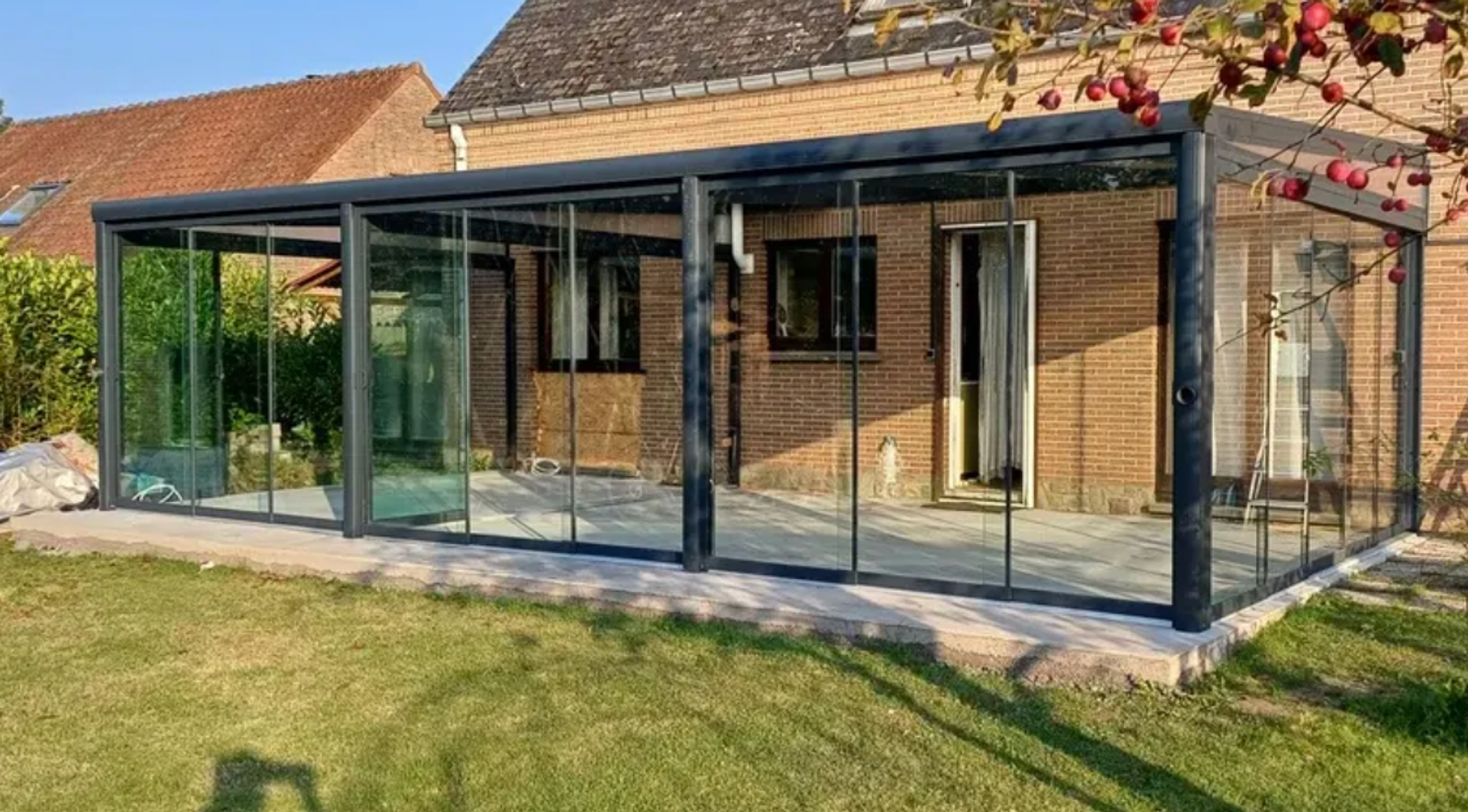
Lighthouses is a Belgian specialist in terrasoverkappingen, carports, glasschuiframen and zonwering. The company is led by Kris Lauwers, who has been active in the world of terrace covers since 2001. His approach is deeply personal: he is present on every build site, from the first conversation to the final installation.
The challenge
The digital presence did not match the craft. The website was outdated, there was no brand consistency, no SEO strategy, and no way to track or convert online leads. For a company that earns trust through quality and personal service, the website was actively working against them. The goal: build a digital presence as reliable and well crafted as the terrace covers themselves.
Brand identity from scratch
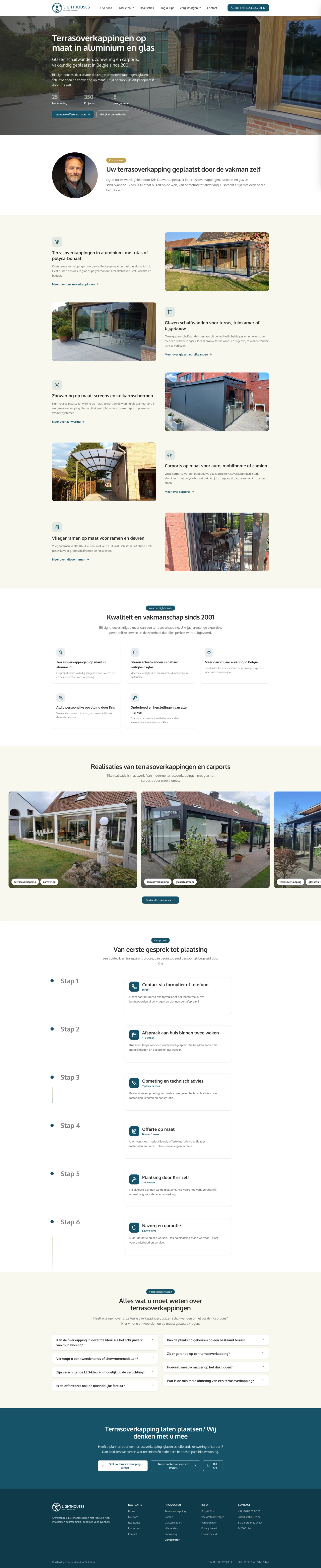
Lighthouses had no visual identity. We created a compact brand system: logo, colour palette, typography and application guidelines, all designed to communicate craftsmanship and premium positioning. The brand was applied consistently across the website, email signatures, business cards with a QR code to Google Reviews, and custom team polo shirts.
Full website redesign in Next.js
We rebuilt the entire site in Next.js with dedicated pages for every service category: terrasoverkappingen, carports, glasschuiframen, zonwering, vliegenramen op maat, montage, and onderhoud en herstellingen.
The homepage was structured around a clear value proposition, a product category overview, a transparent 6-step process from first call to aftercare, and trust signals. Each service page targets specific local search terms and is designed to convert visitors into qualified leads. A realisaties page showcases completed projects, and the contact page features an optimised form with automated email follow-up.
Conversion optimisation: 20+ improvements
After the initial build, we ran a systematic CRO review that resulted in over 20 actionable improvements. Many were implemented in the same sprint:
Sticky phone CTA on desktop and mobile, one tap to call Kris directly
Sticky navigation on scroll, always accessible
Floating WhatsApp button, instant messaging for quick questions
Contact form validation with inline feedback and submission confirmation
Hero image optimisation, an LCP fix with fetchpriority and preload hints
Static Google Maps with click-to-load for faster page performance
FAQ section with an ARIA-accessible accordion
Skip-to-content link and improved image alt text for accessibility
Auto-advancing hero slider replaced with a static image for WCAG compliance
SEO foundation
We conducted keyword research covering the full product range, with a focus on long-tail local queries like "terrasoverkapping op maat Lier" and "glasschuiframen plaatsen". Every page received optimised metatitles and descriptions. JSON-LD structured data (LocalBusiness and FAQPage) was prepared to improve rich results in search. Location landing pages for Antwerpen, Gent and Mechelen were planned to expand geographic reach.
Analytics and tracking
GA4 was set up with conversion tracking from day one. Google Business Profile optimisation was initiated to capture local search visibility and drive reviews. Business cards with a QR code linking to Google Reviews were designed to accelerate social proof collection.
The result
From word-of-mouth craftsman to a conversion-ready digital presence. A complete brand kit, more than seven service pages built to rank, over twenty conversion improvements, and tracking in place from the first sprint.
- Client
- Lighthouses, Lier, BE
- Year
- 2026
- Timeframe
- 4 weeks
- Services
- Branding, Web development, UI/UX Design, SEO, CRO
Built with
 Figma
Figma NextJS
 Tailwind CSS
 Google Analytics
- Google Tag Manager
 Google Search Console
 Semrush
 Cookieyes
The team
 Arthur LauwersFounder
 Wout BlockxShopify expert
How we got there
The decisions that shaped this project, in the order we made them. Open one to see what it answered.
Lighthouses had no visual identity. We created a compact brand system, logo, colour palette, typography and application guidelines, designed to communicate craftsmanship and premium positioning. Applied consistently across the website, email signatures, business cards with a QR code to Google Reviews, and custom team polo shirts.
Dedicated pages for every service: terrasoverkappingen, carports, glasschuiframen, zonwering, vliegenramen, montage and onderhoud. Each page targets specific local search terms and is structured to convert. The homepage flows from a clear value proposition to product categories, a transparent 6-step process, and trust signals.
A systematic CRO review produced over 20 actionable fixes, most implemented in the first sprint. Sticky phone CTA for one-tap calling, floating WhatsApp button, contact form with inline validation, and sticky navigation on scroll. Performance upgrades included hero image LCP fixes, static Google Maps with click-to-load, and WCAG accessibility improvements.
Keyword research across the full product range, with a focus on high-intent local queries. Every page received optimised metatitles and descriptions. GA4 was set up with conversion tracking from day one, and JSON-LD structured data (LocalBusiness and FAQPage) was prepared for rich results.
Before and after
Before
- No brand identity, inconsistent visuals across every touchpoint
- Outdated website, invisible in search for high-intent local queries
- No analytics, no conversion tracking, no structured intake flow
After
- Cohesive brand kit applied to website, email, merch and cards
- 7+ optimised service pages ranking for local long-tail keywords
- GA4 tracking, WhatsApp CTA, sticky nav and 20+ UX improvements