This guide compares Semrush and SISTRIX so European founders and marketing leads can choose the tool that best fits their markets, workflows and budget, not generic “best SEO tool” lists. It focuses on pricing structures, usage limits, European data strength and how each platform impacts real-world ROI.
Semrush: All-in-one marketing suite covering SEO, content, PPC and social. Strong for teams that want one platform, global keyword data and integrated content workflows.
SISTRIX: Focused SEO toolbox with deep European datasets, the Visibility Index and modular pricing that scales by projects, crawls and users.
Lean in-house teams often benefit from SISTRIX simplicity. Multi-channel teams and agencies often prefer Semrush breadth. Some larger teams use both where budgets allow.
If you need help auditing your stack and configuring either tool for growth, a lean embedded team like 6th Man can benchmark options against your goals and capacity.
Choosing between Semrush and SISTRIX is not about picking the "best" SEO tool. It is about understanding which one fits your team, markets, budget and how you actually work. This comparison is built for growth-minded founders, marketing leads and ecommerce operators in Europe who need clarity on what each platform does, how much it costs, where the limits sit, and what that means for real-world ROI. We work with both tools at 6th Man, across B2B and ecommerce clients, so this is not a sales pitch. It is a practical breakdown of pricing structures, usage caps, feature trade-offs and which scenarios favour Semrush vs SISTRIX. If you want straight talk on tooling decisions that impact speed and performance, keep reading.
Who this Semrush vs SISTRIX comparison is for
This article is written for small to mid-sized companies in Europe, especially those in B2B, ecommerce or service-driven sectors with serious growth targets. You are likely a founder, marketing manager or CMO who juggles strategy, execution and budget decisions every day, and you probably already use Google Analytics and Search Console. You care about data, not vanity metrics, and you want marketing tools that pay for themselves in visibility, traffic and pipeline instead of adding more dashboards you never open.
You might be evaluating a switch from one tool to another, comparing pricing tiers before your first purchase, or trying to justify a renewal to finance. Perhaps you have worked with an agency that used one platform, and now you are bringing SEO in-house or partnering with a lean embedded team and need to rethink your stack. You want clarity on where your money goes, what limits will hit you as you scale, and which platform actually supports fast, repeatable SEO workflows instead of slowing them down. This Semrush vs SISTRIX guide focuses on pricing structures, usage limits, European data coverage and real-world value so you can choose a tool that matches your context, team and growth model.
Tooling decision, not tool hype
Semrush vs SISTRIX for growth teams in Europe
Built for founders and marketing leads who care about speed, focus and ROI. Compare Semrush and SISTRIX on features, pricing, limits and real-world fit, then decide what actually moves the needle for your team.
6th Man comparison
Category
Semrush
SISTRIX
Overall philosophy
All in one marketing suite for SEO, PPC, content, competitor research and social. Built for teams that want one platform for multiple channels.
Focused SEO toolbox with strong European datasets. Prioritises clean visibility metrics, ranking history and simplicity.
Strength in markets
Strong global coverage across more than 140 countries.
Exceptional depth in Europe, especially Germany, UK, France, Spain, Italy and Benelux.
Keyword research
Very large global keyword database, Keyword Magic Tool, filters by intent, difficulty and SERP features. Suits international SEO and PPC research.
Extremely accurate datasets where coverage exists, stable Euro region volumes, strong SERP history and ranking distribution insights.
Competitor insights
Domain Overview and gap analysis across SEO and PPC, multi market overlap analysis and opportunity discovery.
Visibility Index shows performance over time, clean competitor comparisons, SERP snapshots, less noise from non SEO data.
Content tools
Full writing toolkit, SEO Writing Assistant, topic research and content scoring. Supports teams that publish content every week.
No integrated writing tools. Focuses on clean SEO data and reporting rather than content production.
Technical SEO
Site Audit checks more than 140 issues, generous crawl limits on higher tiers, scheduled audits and trend reporting for stakeholders.
Optimizer module covers technical audits with a simpler UX, clear crawl data and fast exports that are easy to act on.
Rank tracking
Daily tracking available, strong multi location support and detailed SERP feature reporting.
Weekly tracking on all plans, daily options on higher tiers, excellent historic visibility reporting for domains.
Reporting
Custom dashboards and client reports, joins SEO, PPC and social metrics. More flexible but also heavier to manage.
Visibility Index is a standout, instantly understandable for non technical stakeholders, simple and clean interface.
Pricing structure
Tiered bundles. Pro, Guru, Business. One seat included, additional seats cost extra, often between 45 and 100 dollars monthly per seat. Upgrading usually means a large price jump.
Modular pricing. Start, Plus, Professional, Premium. Multiple seats included from mid tiers. Extra seats cost 24.90 euros monthly. Easy to add crawl credits or projects without changing plan.
Plan limits
Limits tied to projects, tracked keywords, crawl pages and reports. Example Pro plan, 5 projects, 500 tracked keywords, 100,000 crawl pages monthly.
Limits tied to projects, crawl URLs and SERP update credits. Example Start plan, 3 projects, 30,000 crawl URLs, 2,500 SERP updates, research queries are effectively unlimited.
Scaling usage
Upgrades can become expensive because seats and features are bundled. Heavy users hit keyword and project caps quickly.
Scales efficiently for teams. Simple to add seats and credits. Very attractive for European agencies and multi market SEO teams.
Ease of use
Feature rich but more complex. New users must learn many modules before they feel fast.
Very intuitive. Clean layout and navigation, founders and non specialists can get value on day one.
Who it suits best
Teams needing one platform for SEO, content planning, basic paid insights and international coverage. Agencies that want reporting, PPC and SEO in one tool.
European SEO teams, DACH and Benelux markets, founders who want clarity without bloat. Perfect for visibility tracking and competitor benchmarking.
Drawbacks
Can feel bloated for pure SEO use. Costs rise fast with extra seats and heavy usage.
Less global depth. No content suite. Focused product so fewer cross channel features.
Real world ROI
High ROI when you actually use multiple channels from one place. Less efficient if you only need SEO data.
High ROI when your focus is European SEO, competitive tracking and visibility reporting that stakeholders understand in one chart.
Semrush vs SISTRIX: core features side by side
Semrush is an all-in-one marketing suite with a strong SEO foundation, covering keyword research, rank tracking, site audits, backlink analysis, content tools, PPC research and social media planning. SISTRIX is a focused SEO toolbox built around its proprietary visibility index, modular structure and deep keyword datasets, especially for European markets. Both are widely used and respected, but they serve different workflows and philosophies. Semrush aims to be your single platform for organic and paid channels, while SISTRIX doubles down on precision SEO intelligence and simplicity.
The comparison below breaks down how each platform handles the core jobs most small to mid-sized teams rely on every week. We look at keyword and competitor research first, then content creation, technical SEO, rank tracking and reporting. Throughout, we focus on practical impact, not just feature checklists, and we highlight where European data coverage and ease of use make a real difference for teams that move fast and measure everything.
Keyword and competitor research
Both Semrush and SISTRIX excel at keyword discovery and competitor analysis, but they approach the task differently. Semrush offers a massive global keyword database, covering over 20 billion keywords across more than 140 countries, with tools like Keyword Magic that filter by intent, difficulty, search volume and SERP features. It adds keyword difficulty scores, CPC estimates and trend data that support both SEO and paid search, while Domain Overview and Gap Analysis show which keywords your competitors rank for, where they overlap with your site, and which opportunities you are missing across multiple markets.
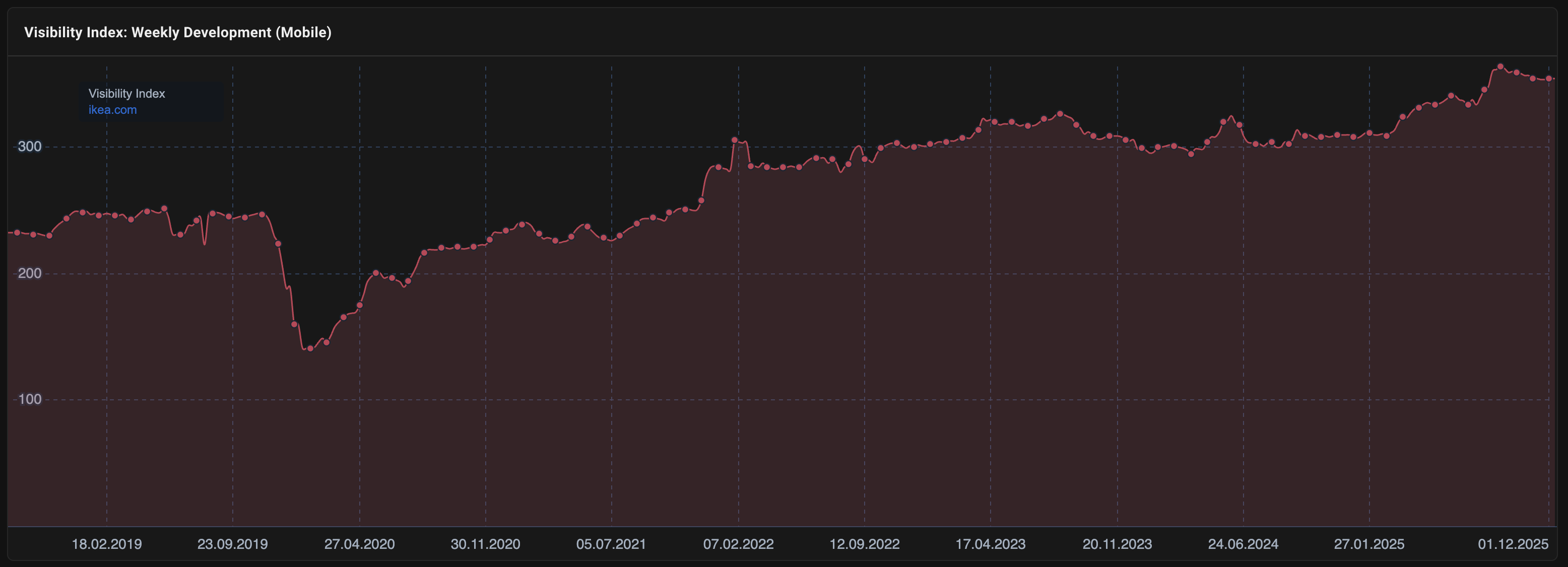
SISTRIX takes a more focused approach with particularly strong coverage in German-speaking countries, the UK, France, Spain, Italy and increasingly the Benelux region. Where it covers a market, the depth and accuracy are excellent, and the standout feature is the SISTRIX Visibility Index, a single score that tracks how visible a domain is in organic search over time. You get detailed SERP history, ranking distribution analysis and clean competitor insights on backlinks and top pages, without extra noise from ads or social data. For European-focused businesses, especially those comparing Semrush vs SISTRIX vs SEO point tools or reading Semrush vs SISTRIX Reddit threads, that visibility metric and local coverage are often the deciding factors.
This is what the visbility index of SISTRIX looks like for Ikea.com.
Content, technical SEO and reporting
Semrush includes a full content toolkit to support lean teams. The SEO Writing Assistant analyses your drafts in real time, suggesting keywords, readability improvements and tone adjustments based on top-ranking competitors, while Topic Research helps you map content clusters and answer high-intent questions. On the technical side, the Site Audit crawls your site for over 140 issues such as broken links, duplicate content, Core Web Vitals and mobile usability, and you can schedule crawls, track fixes over time and pull clear reports for stakeholders who want to see progress, not raw logs.
SISTRIX does not try to replace your CMS or content editor, instead it focuses on a solid Optimizer module for technical audits and exceptionally clear reporting. The visibility index chart is immediately understandable for non-SEO stakeholders, and ranking data is easy to filter by device, SERP feature and location. Rank tracking is reliable with weekly updates by default and daily options on higher tiers, while exports remain fast and uncluttered. Overall, if you want one platform that spans keyword research, content optimisation, technical audits and reporting, Semrush fits that brief. If you prefer a lean, SEO-only stack with strong European visibility metrics and simple dashboards, SISTRIX aligns better with that workflow.
Semrush vs SISTRIX pricing and limits in practice
Pricing is rarely just about the monthly or annual fee. What matters is how much you get for that price, where the caps sit, and what happens when your needs outgrow the base package. Both Semrush and SISTRIX structure their plans differently, and those differences have a direct impact on how much you pay per user, per project and per query. Understanding the models and real limits before signing up can save you from mid-year surprises or forced upgrades that inflate your total spend.
We also look at what happens when you need more capacity. Semrush tends to bundle features into fixed tiers, which means upgrading often means a significant jump in price. SISTRIX uses a modular approach where you can add extra users, projects or crawl credits without jumping to the next plan entirely. For lean teams or agencies managing multiple European markets, those differences are not cosmetic, they determine whether you can scale usage affordably or whether you hit a wall that forces you either to pay more or cut back on tracking and reporting that drive decisions.
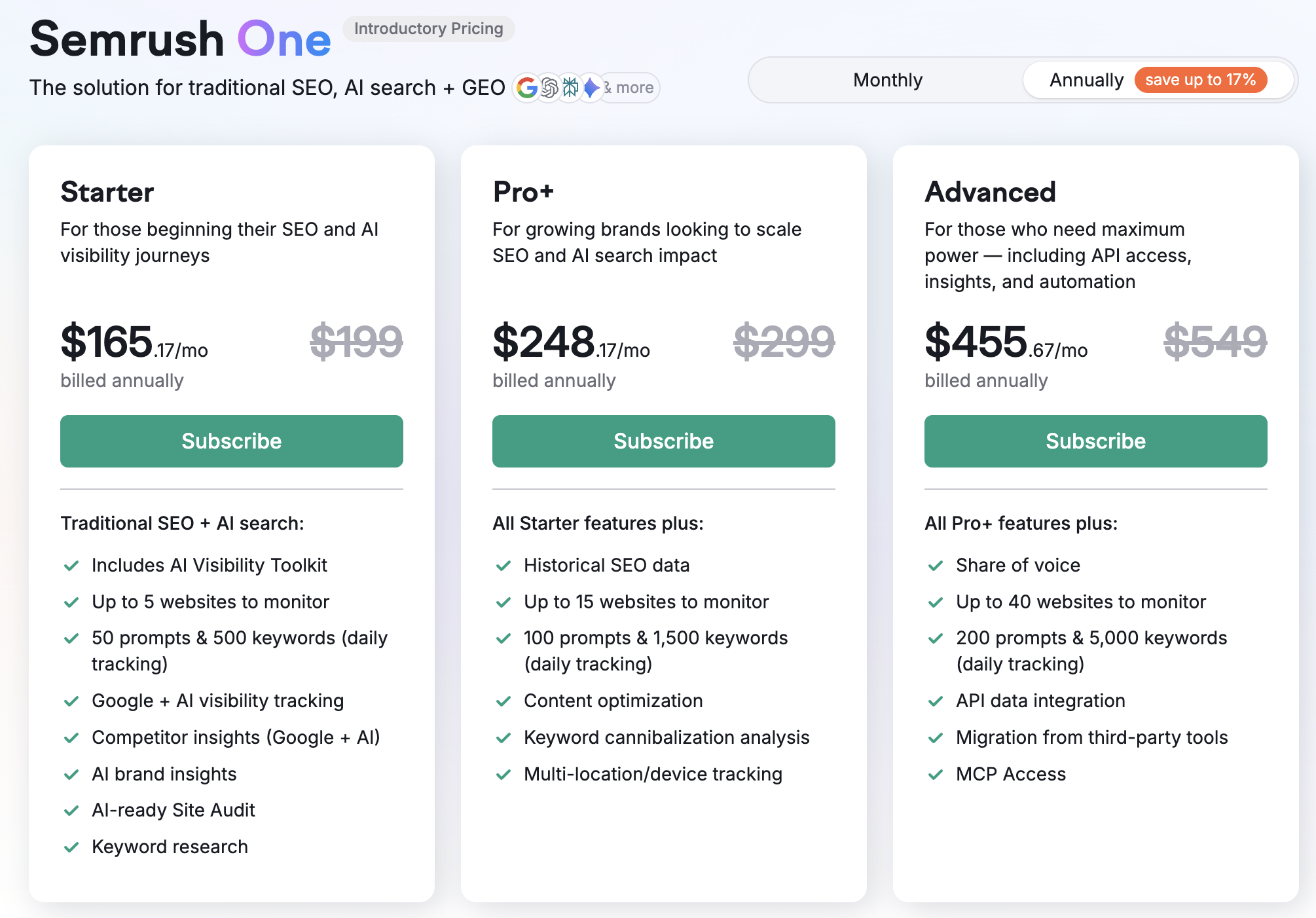
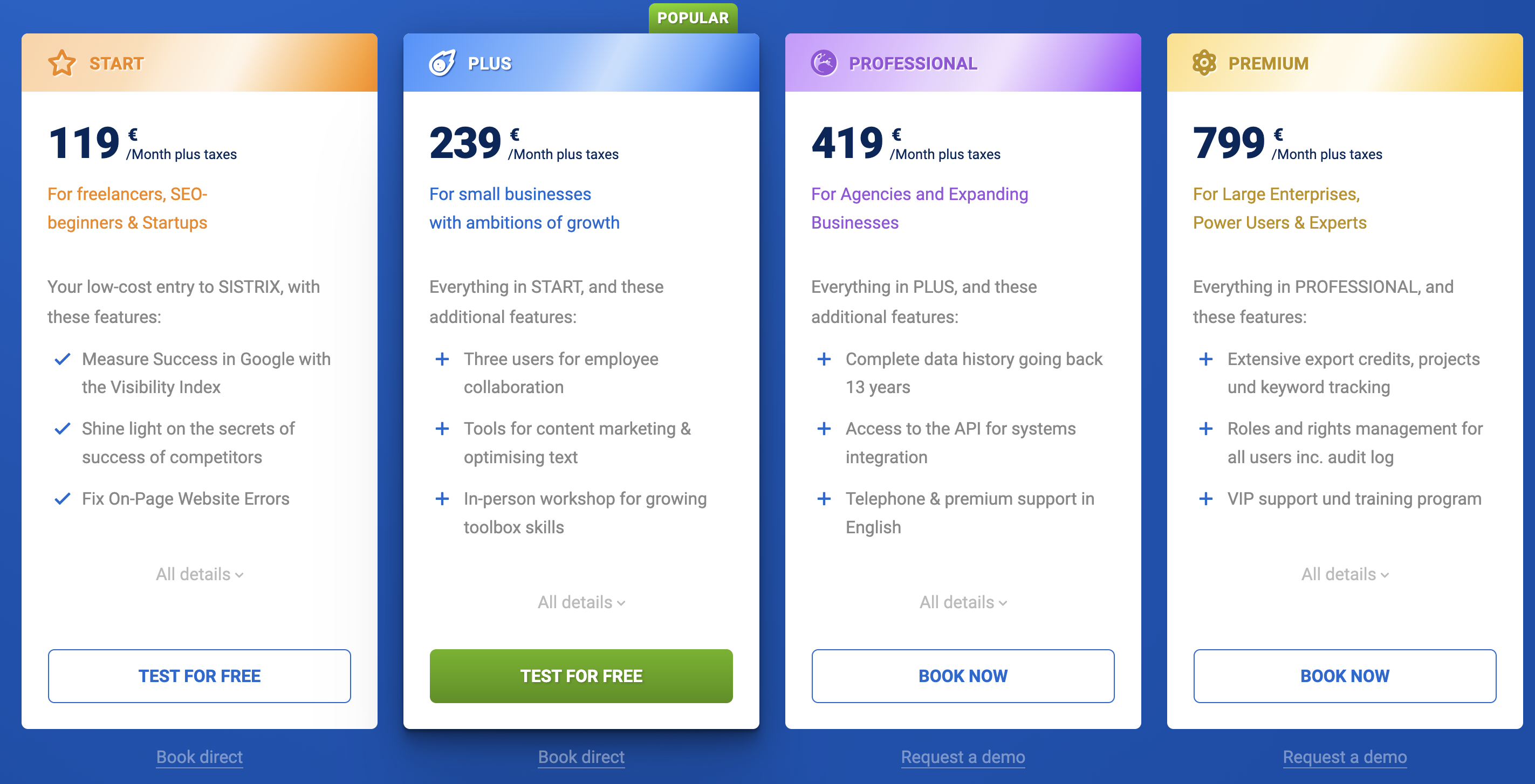
Semrush pricing on December 5th
SISTRIX pricing on December 5th
Plan prices, seats and usage limits
Semrush offers three core plans: Pro at around $139.95 per month billed monthly (or roughly $116 per month annually), Guru at $249.95 monthly (around $208 annually), and Business at $499.95 monthly (about $415 annually). All three include one user seat, with additional seats costing roughly $45 to $100 per user per month depending on your tier, which adds up quickly once founders, in-house marketers and embedded partners all need access. Usage limits scale by plan, from five projects, 500 tracked keywords, 100,000 crawl pages per month and 3,000 reports per day on Pro, through to 40 projects, 5,000 keywords, one million crawl pages and 10,000 daily reports on Business, which suits larger teams that live in keyword research and competitive monitoring.
SISTRIX structures pricing differently, with four main tiers: Start at €119 per month, Plus at €239, Professional at €419 and Premium at €799, all excluding VAT. Higher tiers include more user seats by default, from one on Start up to twelve on Premium, and extra seats on Plus and above cost €24.90 per user per month, making it more team-friendly for collaborative European SEO. Limits focus on projects, crawl capacity and SERP update credits, starting at three projects, 30,000 crawl URLs and 2,500 SERP updates on Start, up to 100 projects, four million URLs and 100,000 updates on Premium, while keyword and domain research within the databases remains effectively unlimited. In practice, that means you often pay SISTRIX for how intensively you track and crawl, whereas with Semrush you pay for a bundled mix of features, seats and limits, which is crucial to understand when evaluating Semrush vs SISTRIX from an ROI perspective.
Which tool fits your team best? real-world scenarios
Lean in-house teams and founders
If you are running a single ecommerce store or B2B site in Belgium, the Netherlands or another European market, your choice usually comes down to simplicity versus breadth. SISTRIX offers clean, focused SEO tools with strong visibility data and excellent coverage for DACH and Benelux regions, and it feels intuitive from day one. That makes it a strong pick for founders or solo marketing leads who need quick wins without climbing a steep learning curve or managing a bloated toolset.
Semrush works better when you want a single platform for SEO, content planning and basic paid media insights. If you are juggling multiple channels and do not want to stack three different subscriptions, Semrush's all-in-one model can streamline your workflow and reduce admin overhead. For small teams with limited time and budget, picking the right fit in the Semrush vs SISTRIX vs SEO-tool debate means asking what you actually need every week, not what sounds impressive on paper.
Agencies and larger SEO teams
If you manage SEO for five or more clients, or run campaigns across multiple countries, you likely need more projects, tracked keywords and user seats than entry-level plans offer. Semrush scales well for agencies that want reporting, content tools and PPC data in one dashboard, and it makes it easier to standardise processes across client accounts. SISTRIX remains a favourite for European-focused shops that prioritise search visibility, ranking history depth and fast reporting over broader marketing suite features.
Some larger teams run both tools in parallel, using SISTRIX for European keyword and visibility tracking and Semrush for broader research, content workflows and international markets. That approach works if you have the budget and headcount to manage two logins. For most lean operations, standardising on one platform keeps workflows faster and more consistent. An embedded growth team like 6th Man can help audit which tools deliver real ROI and which ones just sit idle in the bookmarks bar, then configure dashboards, train teams and adjust your stack as you grow so your Semrush vs SISTRIX decision keeps paying off.
Talk to a team that uses both, not just one
There is no universal winner in the Semrush vs SISTRIX debate. The right tool depends on your markets, channels, budget and how fast you need to move. SISTRIX shines for European SEO, clean visibility data and focused workflows, while Semrush offers broader marketing features, international coverage and an all-in-one approach that can replace multiple subscriptions. Your decision should match your growth model and team capacity, not marketing hype or discounts that expire next month, and real-world feedback such as Semrush vs SISTRIX Reddit discussions can be useful context, not the final verdict.
6th Man Digital operates as a lean, embedded marketing team for B2B and ecommerce businesses across Europe. We work with both Semrush and SISTRIX, plus a range of other tools, choosing what fits each client's strategy and ROI targets. We do not sell software, we sell results, which means we help you select the right stack, configure it properly, build dashboards that drive decisions and turn data into measurable growth. If you want a quick, practical assessment of which tool fits your business best in the Semrush vs SISTRIX comparison, reach out via our contact page and we will talk through your setup, budget and goals.
Frequently asked questions
Semrush vs SISTRIX: comparing pricing, limits and real-world value
For small to mid-sized European companies in B2B, ecommerce or service sectors, particularly founders, marketing leads and CMOs who use Google Analytics/Search Console and need data-driven SEO tooling decisions.
What's the main philosophical difference between Semrush and SISTRIX?
Semrush is an all-in-one marketing suite covering SEO, content, PPC and social planning, while SISTRIX focuses on precision SEO intelligence with a proprietary visibility index and modular European datasets.
Which tool has better European coverage?
SISTRIX has particularly strong depth and accuracy in German-speaking countries, the UK, France, Spain, Italy and Benelux, while Semrush offers broader global coverage across 140+ countries.
How do Semrush and SISTRIX differ in pricing structure?
Semrush bundles features into fixed tiers with per-user seat add-ons and usage caps that can force large upgrades, whereas SISTRIX uses modular tiers with included seats and purchasable add-ons for projects, crawl credits and SERP updates.
Which platform is better for lean in-house teams and founders?
SISTRIX is often better for lean teams seeking simple, focused SEO tools and strong local visibility metrics, while Semrush suits teams that want an all-in-one platform for SEO, content and basic paid insights.
Which platform suits agencies and larger SEO teams?
Semrush scales well for agencies needing reporting, content tools and PPC data across many clients, while European-focused agencies may prefer SISTRIX for visibility tracking, ranking history depth and fast reporting.
Can teams use both tools together?
Yes; some teams run SISTRIX for European visibility and rank history and Semrush for broader research and content workflows if they have the budget and headcount to manage both platforms.
What are typical Semrush plan limits I should watch?
Semrush example limits include 5–40 projects, 500–5,000 tracked keywords and 100,000–1,000,000 crawl pages per month depending on tier, with only one user seat included by default and extra seats costing additional monthly fees.
What are typical SISTRIX plan limits I should watch?
SISTRIX plans start around €119 and include limits such as 3 projects, 30,000 crawl URLs and 2,500 SERP updates on the entry tier, scaling to 100 projects, 4 million URLs and 100,000 updates on Premium, with more user seats included at higher tiers.
How do content and technical SEO capabilities compare?
Semrush provides a full content toolkit (SEO Writing Assistant, Topic Research) and a Site Audit that checks 140+ issues, while SISTRIX offers an Optimizer module for technical audits and very clear, stakeholder-friendly reporting without replacing CMS editors.
What should I consider to choose between them for ROI?
Match the tool to your markets, team size, required projects and crawl intensity; factor in seat costs, usage caps and whether you need an all-in-one marketing suite or a lean SEO-focused platform to avoid unexpected upgrade costs.
Are exports and reporting different between the tools?
SISTRIX delivers clean, fast exports and a single Visibility Index that is easy for non-SEO stakeholders to understand, whereas Semrush provides more extensive, multi-channel reporting tied into content and paid metrics.
How can 6th Man Digital help with this decision?
6th Man Digital works with both Semrush and SISTRIX, offering audits, dashboard configuration, team training and practical assessments to determine which platform delivers measurable ROI for your business—contact them via their website for a tailored consultation.

.jpeg)