If you have ever bought display ads, run programmatic campaigns, or simply tried to understand where your banner impressions come from, you have probably heard the term ad exchange. For many teams, the real question is, what does an ad exchange do in practice for performance, control, and cost.
This quick explainer will walk you through the core job of an ad exchange, how real time bidding works, the differences between exchanges, ad networks, SSPs, and DSPs, and when each type of exchange makes sense for your campaigns. You will also learn what ad exchanges do for advertisers and publishers, how they fit into a 2026 privacy first landscape, and when it makes sense to bring in a team like 6th Man Digital to manage programmatic buying without the bloat of traditional agencies.
What Does An Ad Exchange Do In 2026?
An ad exchange functions as a technology platform that automates the buying and selling of digital ad inventory through real time auctions. Publishers connect their available impressions, advertisers bid through demand side platforms, and the exchange runs an auction in milliseconds to determine which ad appears on the page. In 2026, ad exchanges handle display banners, video, native, audio, and connected TV inventory, making them the backbone of programmatic advertising. They exist to create efficiency, transparency, and liquidity in the ad market, replacing manual insertion orders with automated, data driven decisioning.
Simple Definition For Busy Marketers
Think of an ad exchange as a digital stock market for ad space. Just as a stock exchange connects buyers and sellers of shares, an ad exchange connects advertisers who want to reach audiences and publishers who have ad slots to fill. The exchange does not own the inventory, it simply provides the infrastructure, rules, and speed to match supply and demand at scale. Every time a user loads a webpage or opens an app, the ad exchange triggers an auction, collects bids from multiple advertisers in real time, and serves the winning ad in under 100 milliseconds.
For growth focused marketers, what does an ad exchange do in practical terms? It unlocks access to thousands of publishers and millions of impressions without negotiating individual deals. It lets you target users based on behavior, context, and first party data, not just platform demographics. It also creates pricing transparency, because you bid what you are willing to pay for each impression rather than accepting a fixed CPM from a network. In short, an ad exchange turns fragmented inventory into a programmatic buying opportunity that scales with your budget and goals.
The Core Job Of An Ad Exchange
The primary job of an ad exchange is to facilitate real time bidding between buyers and sellers of ad inventory. When a user visits a website or app, the publisher's supply side platform sends a bid request to the exchange, which then broadcasts that request to connected DSPs. Each DSP evaluates the impression, checks targeting criteria, historical performance, and budget constraints, and submits a bid. The exchange selects the highest bid, sends the creative to the publisher's ad server, and logs the transaction. All of this happens in the time it takes the page to load, typically 50 to 150 milliseconds.
Beyond speed, ad exchanges provide liquidity and competition. Publishers benefit because multiple advertisers compete for each impression, driving up yield compared to direct sales or ad networks with fixed rates. Advertisers benefit because they can access premium inventory at market prices, often lower than what networks charge after taking their margin. The exchange itself typically charges a small platform fee, around 5 to 15 percent of the transaction value, making it more transparent than traditional media buying layers where fees and margins are hidden across multiple intermediaries.
In 2026, ad exchanges also play a critical role in privacy compliant targeting. As third party cookies disappear and regulations like GDPR and ePrivacy tighten, exchanges are integrating first party data, contextual signals, and privacy preserving identifiers such as Unified ID 2.0 and Google's Privacy Sandbox APIs. What does an ad exchange do when cookies are gone? It evolves into a data clean room style marketplace where audience signals are anonymized, aggregated, and matched in ways that respect user consent while still enabling effective targeting. This shift makes exchanges even more important for brands that want reach and performance without breaching privacy rules.
How An Ad Exchange Works Step By Step
Understanding what an ad exchange does becomes clearer when you walk through a single impression lifecycle. The process starts the moment a user loads a webpage or opens an app that has ad inventory. The publisher's ad server sends a bid request to one or more ad exchanges, which then simultaneously forward that request to multiple demand side platforms connected to the exchange. Each DSP evaluates the opportunity in real time based on the advertiser's targeting criteria, available budget, and performance goals. DSPs submit their bids, the exchange conducts the auction, and the highest bidder wins. From page load to ad display, this entire process takes less than 100 milliseconds.
1. Publisher Sends Inventory To The Exchange
The transaction begins when a publisher makes inventory available. Publishers integrate an ad exchange via their supply side platform or directly through APIs. When a user visits a page or opens an app, the publisher's ad server recognizes an available ad slot and packages information about the impression into a bid request. This request includes data such as the device type, browser, IP address, location, page context, and any available first party or contextual signals. The bid request is then sent to one or more ad exchanges that the publisher has integrated with, allowing multiple buyers to compete for that impression in parallel.
Publishers control which exchanges can access their inventory and can set floor prices or block specific buyers or categories. In 2026, publishers are increasingly using whitelists and private marketplace deals to protect brand safety and ensure premium pricing. What does an ad exchange do at this stage? It validates the bid request, checks compliance with exchange policies, and immediately broadcasts the opportunity to all connected DSPs that match the publisher's targeting and quality criteria.
2. DSPs Bid In Real Time
Once the ad exchange sends the bid request to connected demand side platforms, each DSP evaluates the impression within milliseconds. The DSP checks whether the impression matches any active campaign targeting rules, such as geography, device type, time of day, user segment, or contextual keywords. If it is a match, the DSP calculates how much the advertiser is willing to pay based on historical performance, predicted conversion probability, remaining budget, and pacing settings. Each DSP submits a bid back to the exchange along with the advertiser's creative.
Bidding happens automatically and at scale. A single DSP might evaluate thousands of impressions per second, decide which campaigns qualify, and submit bids for each. Advanced DSPs use machine learning to optimize bids in real time, adjusting prices dynamically to maximize advertiser ROI while staying within budget caps. In privacy first environments, DSPs rely on first party data segments, contextual signals, and probabilistic matching rather than third party cookies. What does an ad exchange do here? It collects all bids from all DSPs, runs the auction logic, and determines the winner based on the highest price and any deal priority rules.
3. The Winning Ad Is Served In Milliseconds
After evaluating all bids, the ad exchange selects the winner and notifies both the winning DSP and the publisher's ad server. The exchange sends the creative URL or ad markup to the publisher, which then renders the ad on the user's device. The entire auction and delivery process typically takes between 50 and 150 milliseconds, meaning the ad appears on the screen almost instantly as the page loads. The exchange logs the impression, records the final price, and handles billing, while the DSP tracks the impression for campaign reporting and optimization.
This real time decisioning is what makes ad exchanges efficient. Instead of negotiating insertion orders weeks in advance, advertisers bid on the exact impressions they want at the exact moment they are available. Publishers benefit by maximizing yield, because every impression goes to the highest bidder rather than being locked into fixed rate agreements. In 2026, ad exchanges are also integrating dynamic creative optimization and server side rendering to personalize ads on the fly, improving relevance and performance without adding latency.
Ad Exchange Vs Ad Network, SSP And DSP
Ad Exchange Vs Ad Network
When founders ask on forums like "what does an ad exchange do reddit" compared to an ad network, the key difference is control and transparency. Ad networks aggregate inventory and resell it at marked up CPMs, while exchanges expose raw auctions so you see clearing prices, win rates, and can fine tune bidding via your DSP.
Ad Exchange Vs SSP
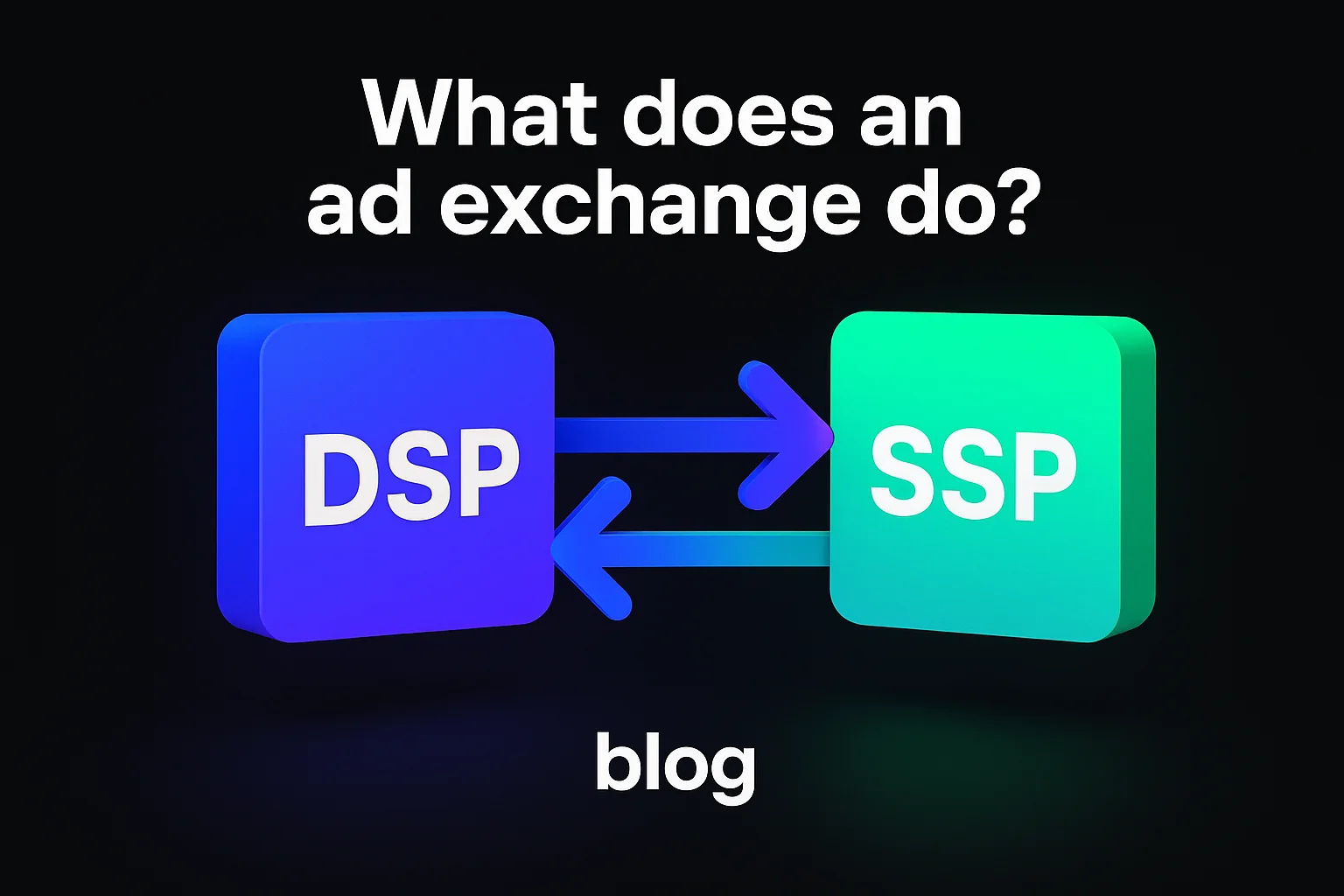
An SSP is a publisher focused tool that manages how inventory is packaged, priced, and connected to multiple buyers. The SSP plugs into one or more exchanges, while the exchange runs the cross market auction. In simple terms, the SSP chooses how to offer supply, and the ad exchange decides which buyer wins each impression.
Ad Exchange Vs DSP
A DSP is an advertiser side platform used to buy impressions across many exchanges and networks. It handles budgets, targeting, frequency caps, and reporting. The exchange never sets campaign strategy, it only executes auctions. For growth teams, the DSP is where you decide your bets, and the ad exchange is where those bets clear.
Programmatic Advertising
Ad Exchange vs Ad Network, SSP, and DSP
What each platform does and who controls pricing, packaging, and bidding.
6th Man comparison
| Category |
Ad Exchange |
Ad Network / SSP / DSP |
| Core purpose (vs Ad Network) |
Runs open auctions across supply. |
Aggregates inventory and resells it. |
| Pricing model (vs Ad Network) |
Shows true clearing CPMs. |
Uses marked up CPMs with hidden margin. |
| Transparency (vs Ad Network) |
Exposes clearing prices and win rates. |
Limited visibility into actual costs. |
| Bid control (vs Ad Network) |
Fine tune bids via your DSP. |
Fewer controls over bidding. |
| Core purpose (vs SSP) |
Runs the cross market auction. |
Packages and prices publisher supply. |
| Connection flow (vs SSP) |
Connects buyers and sellers at auction. |
Plugs into exchanges to reach buyers. |
| Decision rights (vs SSP) |
Chooses the winning bid for each impression. |
Chooses how to offer and route supply. |
| Core purpose (vs DSP) |
Executes auctions for each impression. |
Buys across exchanges and networks. |
| Strategy vs execution (vs DSP) |
Does not set campaign strategy. |
Sets targeting, budgets, and pacing. |
| Controls and reporting (vs DSP) |
Provides auction signals such as win rates. |
Manages frequency caps and reporting. |
Types Of Ad Exchanges And When To Use Them
Open Ad Exchanges
Open exchanges are large, public marketplaces where thousands of publishers list inventory and any approved buyer can bid. They offer reach and lower average CPMs, but quality can be uneven. What does an ad exchange do for you here? It gives efficient scale as long as you apply strict brand safety, whitelists, and performance filters in your DSP.
Private Marketplaces
Private marketplaces, often called PMPs, are invitation only deals where selected advertisers can access premium inventory at agreed floor prices. The auction still runs via the exchange, but with fewer, pre vetted participants. Growth minded brands use PMPs to secure quality placements and predictable delivery without relying only on open exchange traffic.
Preferred Deals
Preferred deals sit between direct buys and auctions. A publisher offers specific inventory to a buyer at a fixed or priority price, and the buyer can choose to take or pass before the impression goes into the open auction. This format works well when you want near guaranteed access to strategic placements without managing full sponsorships.
What Does An Ad Exchange Do For Advertisers And Publishers?
Benefits For Growth Focused Advertisers
For advertisers, what does an ad exchange do beyond buzzwords? It concentrates inventory, data, and pricing signals into one auction layer, so your DSP can optimize across millions of impressions. You gain finer control over bids, frequency, and audiences, see clearer attribution data, and can test new formats like CTV and audio without rebuilding your stack.
Benefits For Revenue Driven Publishers
For publishers, ad exchanges introduce more buyers, more competition, and better yield management. Instead of locked in deals at flat CPMs, each impression can attract bids from multiple advertisers, including those buying programmatically in DV360 or Google Ad Exchange. This dynamic pricing helps monetize remnant inventory while still protecting premium placements via PMPs and preferred deals.
What Does An Ad Exchange Do For Your 2026 Growth Strategy?
Privacy, First Party Data And Targeting
In a cookie free world, the useful question is not only what does an ad exchange do, but how it works with your data. Modern exchanges enable privacy safe matching of first party audiences, server side conversions, and contextual signals so you can keep targeting sharp while staying compliant with GDPR, ePrivacy, and local regulations in Belgium and across Europe.
CTV, Audio And New Channels
Ad exchanges now cover far more than standard web display, reaching CTV apps, digital audio, in game placements, and digital out of home. For ambitious B2B and ecommerce brands, this means you can extend performance thinking into brand channels, using the same bidding, frequency, and measurement logic across your full funnel instead of running isolated tests.
When To Bring In A Partner Like 6th Man Digital
If you find yourself Googling "ad exchange examples" or comparing "ad exchange vs DSP" instead of building strategy, you are likely under resourced on the programmatic side. A partner like 6th Man helps you select the right platforms, design clean measurement, and integrate programmatic with SEO, paid search, and CRO so every euro contributes to long term growth.
Talk To 6th Man About Smarter Programmatic Buying
Understanding what an ad exchange does is one thing. Using that knowledge to drive measurable, profitable growth is another. Most companies struggle not because exchanges are complicated, but because they lack the time, team, or transparency to make programmatic work at scale without inflating costs or losing control.
That is where 6th Man comes in. We are not a traditional agency that marks up media spend or hides behind vague dashboards. We are your embedded growth team, combining senior level expertise in programmatic advertising, SEO, paid media, and conversion optimization with a lean, agile model that plugs directly into your business. We help you decide if and when to use ad exchanges, which DSPs and deal types make sense for your goals, and how to connect programmatic buying to first party data, privacy compliant targeting, and emerging channels like CTV and audio.
Whether you are a B2B company trying to break through to new enterprise accounts or an e commerce brand looking to scale customer acquisition profitably, we bring the cross vertical experience and strategic thinking you need to make programmatic part of a broader, data driven growth strategy. No bloat, no junior staff, no hidden fees. Just clear reporting, fast execution, and a relentless focus on results that move the needle for your business.
If you want to explore how ad exchanges, DSPs, and smarter programmatic buying can fit into your 2026 growth plan, and fully answer the question "what does an ad exchange do" for your team, talk to 6th Man today. We will show you what works, what does not, and how to make every euro count.

.jpeg)
.jpg)