- Shopify
- Platform
Shopify updates October 2026: what's new
Canvas, Rollouts for discounts and catalogs, batch fulfillment, DHL labels in the Netherlands and more: every Shopify update from October 2026, explained.

By Arthur LauwersFounder
Sees the whole floor. Calls the play, picks the shot, keeps the scoreboard honest.

October 2026 was a busy month for Shopify. The biggest news for merchants: Canvas, a new visual workspace to design your store with Sidekick, and Rollouts that now also schedule and test discounts and catalogs. Operations got batch fulfillment and stock counts, and merchants in the Netherlands can now buy DHL labels straight from Shopify.
Below you'll find the relevant updates from October, grouped by theme. Per update: what changed, who it matters for and what you should do. Each item links to Shopify's own announcement.
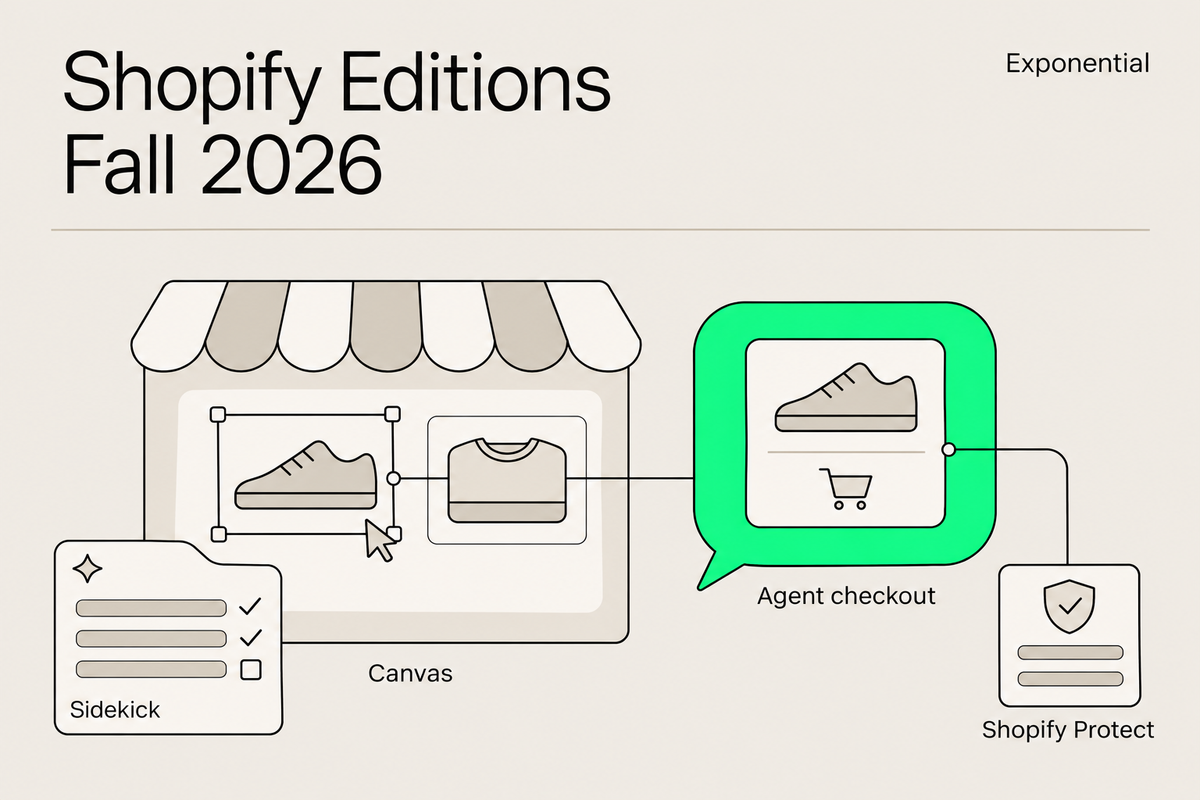
On 28 October Shopify also launched its Fall '26 Edition (codename Exponential) with more than 150 updates. The biggest: selling through AI agents such as ChatGPT and Gemini, a rebuilt Sidekick that carries out tasks in your admin, Shopify Protect against fraud and chargebacks, and the end of script tags on 1 March 2027. What we think of each update and what to do now, you read in our Shopify Editions Fall 2026 explainer. Below are the updates that have already landed in the changelog. Announced features without a firm date, such as selling in Google Search and AI Mode or custom checkout fields, we'll follow up on once they roll out. Source: Shopify Editions.
Online Store & themes
Canvas: design your whole store in one workspace
Since 1 October, Shopify is rolling out Canvas, a new design surface that shows all your store pages in one interactive workspace. Click an element to edit it, or describe the change to Sidekick and watch it happen in real time. You create a new Canvas theme or duplicate a theme into Canvas from Online Store > Themes; your original theme stays in the regular editor. Shopify changelog.
What to do: try it on a duplicate, not on your live theme. At launch Canvas doesn't support Theme Store themes, Markets, translations, rollouts, app blocks or app embeds, and themes edited in Canvas no longer receive theme updates. For a multilingual or multi-market store, that's a reason to wait.
Protection against unexpected redirects
Since 20 October, storefronts can warn shoppers before they leave for an external website. After an update on 23 October, Shopify only blocks links to sites it flags as malicious and asks for confirmation only on suspicious sites; other external links open as usual. Connected domains and supported Shopify and social sites never trigger the message. Shopify changelog.
What to do: if you link to a domain you own but haven't connected to your store, such as a separate brand or booking site, click through those links and check whether a warning appears.
Automatically generated store policies
Since 8 October, Shopify can generate five policies for you: return and refund, contact information, terms of service, shipping and legal notice. They stay up to date when your store settings change. You turn them on per policy in Settings > Policies with 'Use automated policy'. Shopify changelog.
What to do: useful for a new market or a fast launch, but you remain responsible for your policies. Read the generated text and check it against the rules in your countries before you rely on it.
Checkout & payments
New tiled design for payment methods
Since 22 October, checkout can show payment methods in a compact tiled layout that makes the options easier to see. The tiles appear when your payment methods meet certain display criteria, for example four or fewer methods; otherwise the standard list stays. Shopify changelog.
What to do: nothing to configure. Place a test order on mobile and check how Bancontact, cards and your other methods look.
Faster checkout and synced carts via Shop
Since 5 October, Shop can recognise shoppers while they browse your store, before they buy. For Shop users that means faster checkout loading, carts synced across devices, one-tap sign-in to customer accounts and a Shop Pay button prefilled with their last card. Shop can also remind them of abandoned carts. Shopify changelog.
What to do: if you offer Shop Pay, you benefit automatically. Check how this fits your cookie and privacy setup; the announcement doesn't describe opt-out options.
One policies link in checkout: the checkout footer now shows a single 'Terms and policies' link that opens all your policies in a modal. Plus merchants can replace it with their own links via Checkout UI extensions (26 October). Changelog.
Subscriptions in draft orders: you can now add subscription products from your subscription app to a draft order and send the customer a checkout link to complete it (28 October). Changelog.
Markets & international
Guaranteed flat-rate shipping with Managed Markets
Since 24 October, Managed Markets also sets your international Standard and Express shipping rates per destination. Part of the shipping cost is built into product prices, the rest is charged at checkout. When you buy qualifying prepaid FedEx or DHL Express labels through Managed Markets, you're not billed for later carrier cost adjustments. Shopify changelog.
What to do: this requires duty-inclusive pricing and you can't edit the rates yourself. Use the price previews per market to check prices, checkout totals and payouts before you switch it on.
Translate & Adapt: auto-sync in up to 8 languages
Since 9 October, merchants in Belgium, the Netherlands and other European countries can let Translate & Adapt translate new and updated content automatically every week. Shopify now translates in up to 8 languages instead of 2, and translations you wrote manually are never overwritten. The 'Auto-translate' button is now called 'Translate now'. Shopify changelog.
What to do: selling in Dutch, French and English? Turn on Auto-sync per language in Translate & Adapt, and keep reviewing key pages like your homepage and product pages by hand.
EU product identifiers required on labels from 1 November
From 1 November 2026, the EU requires three product identifiers for every item in direct-to-consumer parcels under €150. When you buy Shopify Shipping or Managed Markets labels for EU-bound orders, Shopify adds them to the label and customs documents from your product data. You can't buy a label for items missing a required identifier, and parcels without them risk being rejected at customs with return-to-origin fees. This mainly affects merchants shipping into the EU from outside it, for example from a UK or US warehouse. Shopify changelog.
What to do: add a GTIN or EAN as barcode to each product (or declare that it has none) and, if you have it, the manufacturer's model or part number as NS-PID; your own SKU also works. Use the bulk editor for large catalogs. Buying labels outside Shopify? Check with your carrier or fulfillment partner.
GTIN suggestions in admin: Shopify now checks barcodes against the GS1 registry, suggests the GTIN type for barcodes that look like real GTINs and lets you accept suggestions in bulk. Useful for getting your product data ready for the new EU rules (29 October). Changelog.
For UK sellers: UK VAT on Great Britain orders now follows the fulfillment location chosen by order routing (23 October), and you can offer Royal Mail pickup points at checkout (15 October).
Shipping & operations
Fulfill orders in batches
Since 16 October, you can group up to 250 fulfillments into a batch, for example by product type or destination, and process them together in three steps: pick, print and pack. Scanning items while packing gives a green check, or an error tone for wrong items. You can rename, reorder and add steps and assign a staff member per step. Shopify changelog.
What to do: shipping more than a handful of orders a day? Select orders on the Orders page, click 'Create batch' and compare it with your current packing flow.
DHL labels in Shopify, now in the Netherlands and Poland
Since 16 October, merchants in the Netherlands can buy DHL eCommerce labels directly in Shopify for domestic orders, dropped off at a DHL service point or locker. Merchants in Poland can ship to other EU countries. Rates are discounted, there's no fee on top of your plan, and tracking is added to the order automatically. Shopify changelog.
What to do: Dutch merchants can open an unfulfilled order and click 'Create shipping label'. Belgium isn't included yet.
Buy shipping labels automatically with Shopify Flow
Since 15 October, a Shopify Flow action buys shipping labels automatically for orders that meet your conditions, such as a tag, specific products or single-item orders. You choose the carrier, service, package type, weight and ship date. Shopify changelog.
What to do: start from the ready-made Flow template and limit it to simple orders first.
Stock counts in Shopify admin
Since 20 October, you can create and schedule stock counts in admin, add products by search or barcode, and assign counts to staff who complete them in admin or POS. Managers review the differences before stock levels change, with new permissions for who can count and who can approve. Shopify changelog.
What to do: retire the stock count spreadsheet. Set the approval permissions first, then plan your next count in admin.
Manage variants on the product page
You now edit variants directly on the product page, without switching between product and variant pages. You can search, filter and group variants by option, switch between a detail and a table view, and change price and shipping fields across several variants at once. Plus merchants can turn it on now through Test Drives and will be opted in automatically on 12 December; for everyone else it rolls out gradually from December. Shopify changelog.
What to do: nothing to configure. On Plus, try it now through Test Drives so your team doesn't meet a new product page in the middle of the December rush.
Shopify Flow: staff now need permissions
Since 28 October, Flow uses the regular staff permissions in your admin. Access runs through the 'Flow automations' permissions in Settings > Users > Roles, and Flow checks every step against the staff member's other permissions: testing or turning on a workflow with the 'Add customer tags' action, for example, needs the 'Edit customers' permission. Without them, staff can still build workflows and save drafts, but can't test, turn on or view run details. Workflows that are already on keep running, and the store owner keeps full access. Shopify changelog.
What to do: review your team's roles and give whoever manages automations the permissions they need, including 'Manage connections and secrets' for anyone working with connections.
Purchase order reports: new reports in Shopify Analytics cover purchase order costs, transfers, shipments, receiving and open orders (6 October). Changelog.
Refreshed Shopify app: the iOS and Android app is faster and has a mobile-first redesign (13 October). Changelog.
POS smart grid suggestions: POS suggests smart grid tiles based on how your store uses it (12 October). Changelog.
Three new languages: admin now supports Arabic, Urdu and Hebrew (2 October). Changelog.
Waive outstanding balances: you can now waive an order's outstanding balance from the order page. There's a new 'Waive order balances' permission and a new 'Write-offs by order' report. Customers see the waived amount in their account, at checkout and in emails (29 October). Changelog.
Identify more in-store customers: POS links shoppers who paid at a Shopify Payments store before to a customer profile when they choose a digital receipt, so staff don't have to ask for contact details. Requires POS 11.17, Shopify Payments for POS and Shopify Network Intelligence (28 October). Changelog.
AI & Sidekick
Sidekick helps configure checkout and customer accounts
Since 13 October, Sidekick works in the desktop checkout and accounts editor and in the Checkout Blocks app. Ask how to configure settings, get app recommendations, or have payment, delivery and validation functions explained. Shopify changelog.
What to do: handy for small checkout tweaks. For bigger customisations, keep testing before you publish.
Compare-at prices now shared with AI shopping agents
Since 9 October, Shopify shares your compare-at price with AI shopping agents through Shopify Catalog. Before, agents only saw the current price, so your markdowns were invisible to them. Shopify changelog.
What to do: check the 'Compare-at' toggle in your catalog mapping settings in admin, and make sure your compare-at prices are correct and follow the EU rules on price reductions.
Knowledge base for AI agents now in admin
Since 26 October, Knowledge base is built into admin under Sales channels > Agentic > Knowledge base. It's one page to review, edit and publish the facts AI agents use about your store, such as contact details or gift services. Shopify drafts these facts from your storefront pages, but nothing reaches AI agents until you publish it. It replaces the Knowledge Base app, which stops being available after 15 January 2027. Shopify changelog.
What to do: review the drafted facts and publish the ones that are correct. Used the app with more than 1,000 facts? Those weren't moved over, so add the facts you want to keep before 15 January 2027.
Sidekick tests suggestions for your store
Since 28 October, Sidekick suggests improvements to your online store, builds a draft version and compares it with your current storefront using simulated shoppers (SimGym). It covers theme changes that are expected to affect add-to-cart behaviour. Sidekick's suggestions now also use web search for market and industry context, alongside your own store data. Suggestions appear on your admin home page when they're available. Shopify changelog.
What to do: treat it as a good first hypothesis, not proof. Results come from simulated shoppers, not real visitors or a live A/B test. Only apply a suggestion after you've reviewed it yourself, and prefer testing bigger changes with a rollout.
Transparent images in Sidekick: Sidekick can now generate images with transparent backgrounds for store and marketing graphics (23 October). Changelog.
Faster admin search: in the redesigned desktop admin you find pages, settings and apps faster with Cmd+K or Ctrl+K, and can ask Sidekick from the same flow. Rolling out gradually (28 October). Changelog.
Marketing & analytics
Rollouts: schedule and test discounts and catalogs
Rollouts got two big additions. Since 2 October you can include discounts: launch an offer to part of your online store traffic, compare it with existing offers and expand it later. Since 23 October Rollouts also handles catalog changes, so you can schedule product availability and pricing per market. Both can go live together with theme and checkout changes in one rollout.
What to do: planning Black Friday? Prepare your discounts and catalogs as a rollout now, so everything goes live at the same moment without a late-night shift. Existing customer eligibility rules on discounts still apply.
Campaign Autopilot now for all merchants
Since 28 October, Campaign Autopilot is available to all merchants. You set a budget and guardrails, and Autopilot builds a cross-channel campaign: Meta Ads, Microsoft Advertising, Snapchat, Shop and Shopify Messaging, with X Ads coming soon. It shifts budget toward the best-performing channels and suggests SEO optimisations for you to approve. Shopify changelog.
What to do: test it with a small budget from the Growth tab in admin and compare the results with your existing campaigns. Always review SEO suggestions before approving them. The announcement doesn't say which countries it covers, so check whether it shows up in your admin.
Notes in Shopify Analytics: add internal business context directly to your analytics (1 October). Changelog.
WhatsApp automations in Shopify Messaging: automatically send WhatsApp messages for abandoned browse, cart or checkout, or add WhatsApp to your own automations from Messaging > Automations (28 October). Changelog.
Product data per sales channel: a new channel mapping page lets you set which data each channel receives, combine fields (such as brand plus title), override values per product and see how complete each field is (28 October). Changelog.
Bubble maps in Shopify Analytics: see on a map where your orders and sales are concentrated, starting with the 'Order hotspots by shipping location' report (28 October). Changelog.
App activity in your reports: apps that support App Events now show their activity, such as marketing emails sent or loyalty rewards redeemed, alongside your other numbers in Shopify Analytics (28 October). Changelog.
Apps & developers
Next Gen Events are generally available
With API version 2026-10, Events are the declarative replacement for classic webhooks, across 18 topics. A subscription defines which changes trigger a delivery and which GraphQL data the payload contains, so your app needs fewer follow-up API calls. Classic webhooks keep working. Shopify developer changelog.
What to do: migrate one flow at a time, starting with handlers that discard most deliveries or make extra API calls. Use Shopify CLI 4.83 or later.
Hydrogen 2026-10 works with any framework
Since 14 October, Hydrogen is a JavaScript library that works with any framework, with starters for React Router and Next.js and 20 skills for coding agents. Oxygen hosting stays free, and existing Hydrogen storefronts keep working without changes. Shopify developer changelog.
What to do: running a headless store? Nothing is urgent. Plan the move when it suits you, using the migration skill.
Global Catalog REST API stops on 2 November
The Global Catalog REST API stops serving traffic on 2 November 2026. Apps need to move to Global Catalog MCP, which implements the Universal Commerce Protocol. Existing bearer tokens keep working. Shopify developer changelog.
What to do: using this API? Migrate before 2 November, or your requests will fail.
Public apps: expiring offline tokens before 1 January 2027
Public apps must move from non-expiring to expiring offline access tokens. From 1 January 2027, apps that haven't are delisted from the App Store and blocked from new installs. From 15 January merchants see warnings in admin, and from 1 April 2027 Admin API requests with an old token return a 403 error. Custom apps and merchant-built apps are excluded. Shopify developer changelog.
What to do: building a public app? Migrate your existing installations now. As a merchant using public apps from smaller developers, check that they're ready.
carts/update webhooks: cart updates that change nothing no longer trigger the webhook (12 October). Changelog.
Checkout and Customer Account UI extensions: a new owner_type field for metafield declarations becomes required in API version 2027-01 (8 October). Changelog.
Polaris 2.0: now stable (22 October). Changelog.
AI Toolkit security check: scan your app for vulnerabilities and get fix guidance before you submit and on every release (15 October). Changelog.
Theme app add-ons: theme developers can now bundle an app with their theme in the Theme Store, so merchants install theme and app in one go (28 October). Changelog.
All API changes for this quarter are in the 2026-10 release notes.
What this means for your store
October was mostly about control: schedule and test changes with Rollouts, design visually with Canvas, and run warehouse work with batches and stock counts instead of spreadsheets. With Black Friday close, the most useful things to do now are setting up your promotions as a rollout and testing your checkout on mobile. Not sure which updates are worth it for your store? At 6th Man we build and improve Shopify stores every day, and we're happy to think along.
What people ask about this.
Canvas is a new design workspace Shopify launched on 1 October 2026. It shows every page of your store in one interactive view, so you can edit elements directly or ask Sidekick to make the change. At launch it doesn't support Theme Store themes, Markets, translations or app blocks, and themes edited in Canvas no longer receive theme updates.
Since October 2026 Rollouts also covers discounts and catalogs. You can schedule a discount or catalog change for a set date and time, test it on part of your online store traffic, and launch it together with theme and checkout changes in a single rollout.
Yes. Since 16 October 2026, merchants in the Netherlands can buy DHL eCommerce labels directly in Shopify for domestic orders, dropped off at a DHL service point or locker. Merchants in Poland can ship to other EU countries. Rates are discounted and there's no fee on top of your Shopify plan.
We build, migrate and grow Shopify stores.
One team for the build, the move to Shopify and the growth after launch, so nothing gets dropped at a handoff.

Read also
- Platform
- Shopify
10 Things That Surprised Me in Shopify’s Winter '26 Update and What It Means for Your Store
Deep dive into Shopify Winter '26 update: AI, experiments, checkout and catalog changes, plus what they mean for growth, ROAS and ecommerce teams.
 Arthur Lauwers

- Platform
- Shopify
Shopify Payments declined, on hold or closed: what now?
Shopify Payments declined, payouts on hold or your account closed? Which products are prohibited, why Shopify steps in and what to do next.
Arthur Lauwers
- Platform
- Shopify
Connect Shopify to Exact Online
Connect Shopify and Exact Online for orders, invoices and stock. App, platform or custom: what fits? 6th Man from Ghent sets up your integration end to end.
Arthur Lauwers