- Platform
- Shopify
10 Things That Surprised Me in Shopify’s Winter '26 Update and What It Means for Your Store
Deep dive into Shopify Winter '26 update: AI, experiments, checkout and catalog changes, plus what they mean for growth, ROAS and ecommerce teams.

By Arthur LauwersFounder
Sees the whole floor. Calls the play, picks the shot, keeps the scoreboard honest.
Shopify's Winter '26 Edition, called The Renaissance Edition, is one of the most ambitious releases Shopify has ever produced. With more than 150 updates touching AI, storefronts, checkout, workflows, and experimentation, the Shopify Winter update is a clear signal of where ecommerce is heading in 2026. Here are the 10 things that genuinely surprised me, plus what they mean from the perspective of someone who cares about growth, conversion and advertising performance.
The drop
Shopify Winter Editions 2026 dropped like a bomb. After years of steady updates, Shopify flipped the entire script with a release that feels less like a product update and more like a complete platform reinvention. This is not about adding a feature here or polishing a button there; it is about changing how merchants build stores, test ideas, and reach buyers. The Renaissance Edition signals a major shift: Shopify is no longer just a platform, it is becoming an operating system for commerce in 2026.
For anyone running a Shopify store, scaling ads, or optimizing conversion, the implications are clear. Shopify has built infrastructure that removes friction from experimentation, accelerates testing cycles, and gives you the tools to compete without relying on massive teams or deep technical knowledge. The gap between testing and scaling just got a lot smaller, and that is where the real power of this Shopify Winter update lives.
1. Shopify launched two products outside of Shopify: Tangle and Tinker
I did not expect Shopify to launch two entirely separate, standalone products. Not Shopify apps, not integrations, but full products that work independently of Shopify itself, which is a major strategic shift in how we think about the platform. Tangle and Tinker represent Shopify's move beyond its own walls, and both bring value to anyone serious about testing and optimization, whether you are on Shopify or not. For teams already working with structured testing or embedded growth partners, this opens the door to much faster experimentation.
Tangle
Tangle is an open source, platform agnostic experimentation platform with a visual editor. It lets you run A/B tests without needing Shopify and without heavy engineering work, so you can test experiences, flows and landing pages across any platform. It is built for teams who want to move fast but lack dedicated dev resources and want experimentation baked into their marketing rhythm. Tangle democratizes testing, giving marketers and product teams faster cycle times and fewer bottlenecks before they commit real budget.
Tinker
Tinker is an AI sandbox where you can try new AI tools before merging them into your actual workflow. It acts as a safe playground for testing AI features, workflows and automations without risking production environments or breaking live setups. You can prototype, break things and learn fast, which removes one of the biggest barriers to AI adoption: fear of impact on real customers. The result is a smoother path from idea to implementation for everything from merchandising logic to post purchase flows.
What this means for advertisers
You can test creative, landing pages and flows earlier and faster, validating ideas before spending on traffic. Better experimentation equals better ROAS, because you stop paying to send users into untested experiences and instead use budget only on proven journeys. For performance marketers running paid media, the cost of validating an idea just dropped while the speed of iteration increased. That means more learnings per euro spent, cleaner data and faster optimization loops that compound over time.
2. Sidekick is no longer an assistant, it behaves like a junior marketer
Sidekick received a huge upgrade with Sidekick Pulse, a proactive insight engine that surfaces opportunities, problems and recommendations without you digging through reports. It can generate workflows, edit themes, create simple apps and build analytics queries, acting less like a chatbot and more like an embedded analyst. Sidekick does not wait for questions; it scans performance, identifies patterns and flags next actions before you even ask. For small teams, it is the closest thing to having an extra marketer focused only on insights.
What this means for advertisers
You no longer need to go hunting for issues in reporting or GA4. Sidekick Pulse can bring insights to you such as which product category is suddenly outperforming, where conversion is dropping, which campaign landing pages load the slowest, when inventory is blocking your ads from scaling and where users are dropping off in checkout. It reduces time spent on analysis and increases time spent on implementing fixes, which is a clear velocity unlock for teams running ads at scale. You get real time signals without manual dashboards, leading to faster reaction times and cleaner optimization cycles.
3. AI is now built into the entire Shopify platform
AI is powering workflows in storefront building, operations, analytics and customer experiences, and this is the first time it feels like the engine behind Shopify instead of a feature inside Shopify. It is no longer a button you click but infrastructure that runs quietly in the background, making everything faster, smarter and more responsive. From generating product descriptions to surfacing conversion blockers, AI is now embedded across the entire platform and learning from patterns across thousands of stores. Shopify is effectively being rebuilt on top of AI rather than simply adding AI features on the edge.
Attribution and performance insights become much easier to extract as the platform connects behavioural data with revenue outcomes. Campaign optimisation becomes less reactive because Shopify surfaces patterns automatically in ways that echo modern LLM driven tooling. AI generated reports help you spot revenue drivers and blockers without time consuming manual analysis, reducing the need for custom dashboards. For marketers without in house analysts, this is effectively an enterprise level analytics layer included in the platform.
4. Agentic Storefronts let your products appear inside AI chat platforms
Your product catalog can now be discoverable inside platforms like ChatGPT or Copilot, so users can ask AI for product recommendations and your Shopify store can be the one that appears. This is the beginning of a new acquisition channel where AI search becomes a primary discovery layer for commerce. If your products are not structured and optimized for these platforms, you risk becoming invisible in the channels buyers increasingly trust. Shopify is giving merchants the infrastructure to show up where AI conversations happen.
This opens a completely new acquisition channel at the intersection of search and conversation. It is the early stage of AI search becoming a performance channel and, just like classic SEO, the earlier you optimise for it, the cheaper the attention becomes. First movers will capture outsized visibility while others pay more later to catch up, especially in competitive niches and local markets where local SEO and AI recommendations overlap. If you want to go deeper on how AI discovery is evolving, our SEO insights break down what this means for long term visibility.
5. Native A/B testing and rollouts inside Shopify
Shopify now includes built in A/B testing and scheduled rollouts for your theme, without third party apps or constant developer involvement. You can test variations, measure impact and roll back changes instantly, which removes one of the biggest bottlenecks for ecommerce teams. Experiments can run directly in Shopify with real traffic and native attribution, rather than relying on fragile workarounds. This brings experimentation much closer to your day to day merchandising and campaign work.
You can finally test landing pages and variations with proper tracking, and schedule experiments during low traffic hours to reduce risk. You reduce the chance of breaking high spending campaigns because you can roll back instantly, which is a huge win for CRO and ad performance teams. If you want a deeper playbook on what to test, our guide on landing page optimisation and our framework for designing winning landing pages give you a roadmap for prioritising tests. For teams pushing hard on experimentation, this part of the Shopify Winter update is one of the most valuable shifts.
6. SimGym: AI trained to behave like shoppers
Shopify trained AI agents on shopper behaviour across millions of Shopify sessions, then used those agents to create SimGym. These AI shoppers navigate your store, find friction points and simulate conversion paths before you push changes live, acting as synthetic user testing at scale. SimGym runs through your store like a real buyer would, flagging issues, testing flows and predicting conversion impact without needing real visitors. You get feedback quickly enough to fold into your build and launch process.
You can validate whether your new landing page or navigation structure will actually convert before you spend a single euro on traffic. This gives advertisers a new level of confidence and reduces wasted spend during testing, because weak experiences can be fixed before campaigns scale. SimGym removes much of the guesswork and lets you combine AI testing with qualitative tools and UX fundamentals such as those we share in our UX design fundamentals guide. For teams optimising journeys end to end, it is a powerful complement to traditional user research.
7. Product variants expanded from 100 to 2048
This is one of the biggest functional catalog changes Shopify has ever made, allowing a single product to support thousands of configuration combinations. Previously, stores with complex products hit the 100 variant limit quickly and had to split items across multiple product entries or custom setups. Now you can handle massive catalogs with deep customization without fragmenting your data. For brands with complex SKU structures, this is a structural upgrade rather than a cosmetic tweak.
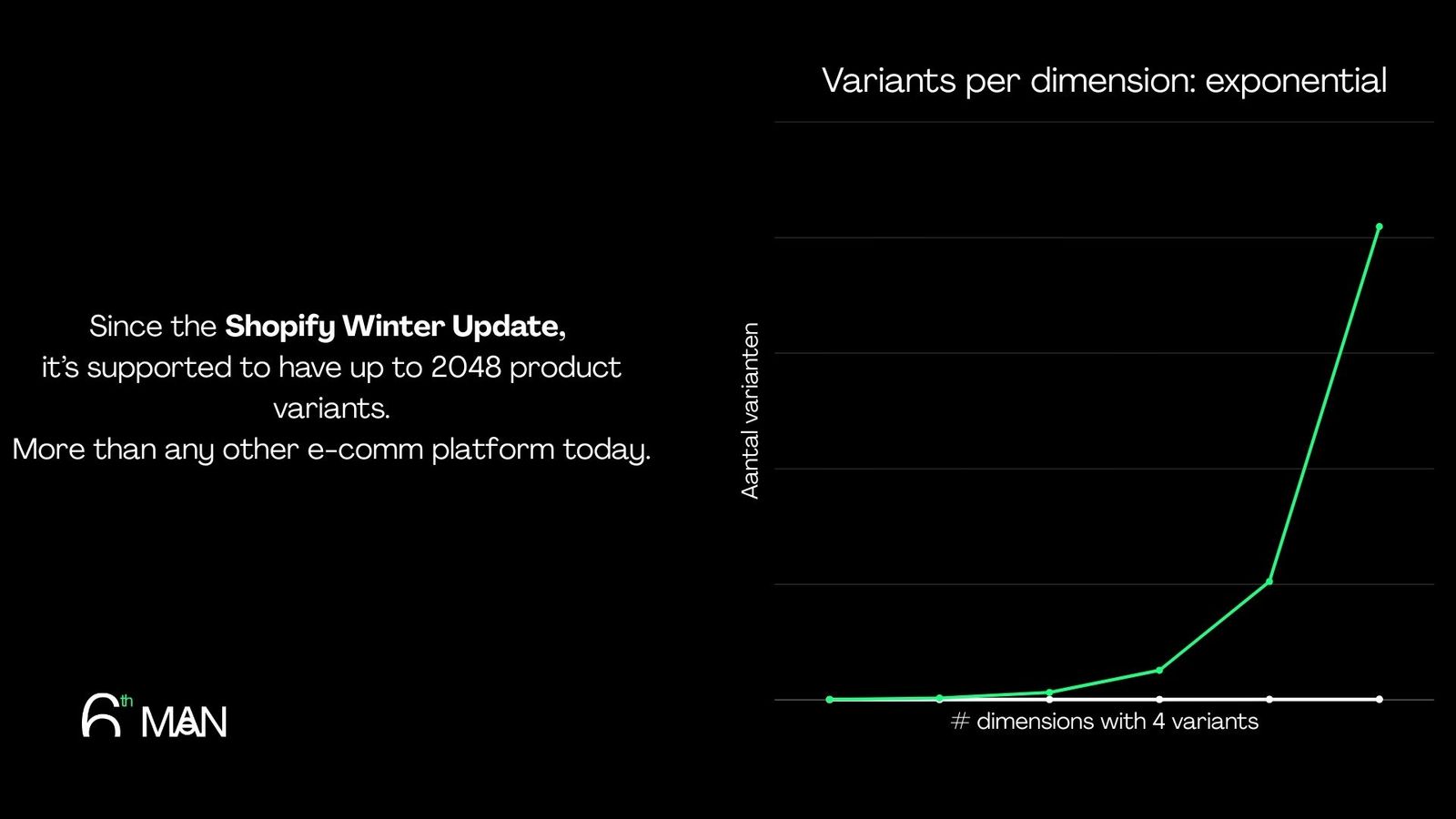
Shopify increased the number of product variants in the Shopify Winter Update.
Who this matters for
This is mostly valuable for large brands or complex catalogs like apparel, furniture and customizable products, where combinations of size, color, material and features explode quickly. Small stores selling a handful of simple variants may not feel it immediately, but for merchants pushing into more complex product lines this removes a major technical ceiling. It simplifies catalog management, reduces feed hacks and makes it easier to maintain a clear product hierarchy. That in turn supports cleaner analytics and more reliable merchandising decisions.
What this means for advertisers
Ad groups and product feeds become cleaner and more complete because you no longer have to spread variants across multiple products. Performance data becomes more accurate, and for dynamic ads this improves relevance while reducing feed errors that quietly drain efficiency. Your catalog becomes easier to manage, your ads become easier to optimise and your data becomes more reliable across channels. That is a clear win for teams running product based campaigns in Google, Meta and beyond.
8. Unlisted products for private links and controlled launches
You can now create products that only appear when someone has the direct link, without showing up in search, collections or navigation. It is a simple feature with massive strategic value because it lets you run private drops, test pricing and launch exclusives without cluttering your main catalog. You gain precise control over who sees what and when, which unlocks new campaign types and launch formats. This is particularly powerful for creators, influencers and brands that rely on scarcity or segmented offers.
You can finally run private campaigns, influencer drops and gated offers without confusing your broader audience. You can test a product quietly with paid ads before giving it a full launch, using dark launches to measure demand and refine positioning. That is ideal for validating new lines, testing bundles or running post purchase offers that tie into structured feedback flows like a post purchase survey in Shopify. You end up taking smarter inventory and marketing risks because decisions are grounded in real response data.
9. Markets aware checkout and account customisation
Checkout and customer account pages can now be customised per region or per buyer type, including B2B. What this means for advertisers You can reduce dropoff in high value markets with localised payment methods, messages and UX. Advertisers running country specific campaigns will benefit from improved checkout consistency with their ads. Better checkout alignment usually means higher conversion rates.
This is a conversion focused update that removes friction at the most critical stage of the customer journey. You can tailor checkout to specific markets with local payment options, currencies and messaging, and you can customise the experience for B2B buyers separately from B2C. That means fewer abandoned carts, higher completion rates and better performance from your ad spend, especially for brands selling into multiple countries where href lang tags and localisation strategies already matter. For local-first brands, this dovetails neatly with local SEO work, local business marketing insights and even broader plays like marketing for local businesses with a webshop or international Shopify expansion.
10. The developer toolkit was upgraded for speed and flexibility
Shopify introduced better APIs, more AI assisted development tools and a more integrated environment for building apps, workflows and storefront logic. It might sound technical, but this has direct impact on performance marketing because better dev tools mean faster changes, cleaner tracking and more reliable feeds. When developers can build faster and with fewer integration issues, marketers get improvements into production quickly instead of waiting through long sprint cycles. That tightens the loop between idea, test and scaled rollout.
Better developer tools lead to faster landing pages, cleaner feeds and more accurate tracking that supports performance marketing and experimentation. When developers can build and test changes faster, advertisers can launch and scale campaigns faster too, which is a real competitive advantage in paid channels. Combined with strong UX and UI principles like those we share in our UI UX design insights and UX fundamentals, this update makes it much easier to align technical execution with growth priorities. If you want help turning these capabilities into revenue, our team can plug in as your on demand partner.
Final thought
The Shopify Winter update is the first release where AI, experimentation and performance are clearly at the center, with more than 150 improvements that make stores faster to build, easier to optimise and much smarter to run. Sidekick now proactively surfaces insights, SimGym lets you test your store with AI shoppers before buying traffic and native A/B testing finally arrives inside Shopify, while features like agentic storefronts, private product links and expanded variants remove bottlenecks across the entire customer journey. For advertisers and growth teams, that translates into faster testing cycles, earlier insights, fewer blind spots and more control over how campaigns translate into revenue. Whether you are focused on organic discovery, paid performance or local growth, this release gives you more levers and cleaner data to work with than any prior Shopify Winter Editions.
These shifts also raise the bar for execution: teams that combine Shopify's new capabilities with strong SEO, structured experimentation and thoughtful local strategies will pull ahead. If you want a partner that can help you align your campaigns, on site experience and analytics with what is now possible on Shopify, work with a team that moves as fast as you do and turn this Renaissance Edition into a practical growth advantage. By the way, I love the Shopify Update page, but Lennert from Otto Creatives thought it was too complex. Guess I'll follow the experts advice? :)
What people ask about this.
The Renaissance Edition is a major Shopify release with over 150 updates that reposition Shopify as a commerce operating system, emphasizing AI, experimentation, storefronts, checkout, workflows and faster testing cycles.
Tangle is an open source, platform-agnostic experimentation platform with a visual editor for A/B tests, while Tinker is an AI sandbox for prototyping and testing AI tools and automations before deploying them to production.
Tangle lets marketers and product teams run A/B tests and iterate on experiences and landing pages without heavy engineering, reducing bottlenecks and accelerating validation across any platform.
Tinker provides a safe playground to prototype AI features, workflows and automations so teams can experiment, learn and break things without impacting live customers or production systems.
Sidekick Pulse is a proactive insight engine that continuously scans performance, surfaces opportunities and issues, and can generate workflows, theme edits and analytics queries to act like a junior marketer or embedded analyst.
AI is embedded into storefront building, operations, analytics and customer experiences as core infrastructure, automatically surfacing patterns, generating reports and linking behavioral data to revenue outcomes across stores.
Agentic storefronts make product catalogs discoverable inside AI chat platforms like ChatGPT and Copilot, creating a new acquisition channel where AI-driven discovery can surface your products to buyers.
Yes; Shopify includes built-in A/B testing and scheduled theme rollouts with native attribution, allowing teams to run experiments on real traffic and roll back changes instantly without third-party apps.
SimGym uses AI shoppers trained on millions of sessions to simulate user journeys, find friction points and predict conversion impact so you can validate changes before spending on real traffic.
Shopify expanded the variant limit from 100 to 2048 per product, enabling much deeper product configurations and simplifying catalog management for complex SKUs and customizable products.
Unlisted products are items that only appear via direct link and are hidden from search, collections and navigation, useful for private drops, influencer launches, gated offers and quiet market testing.
Regional and buyer-type checkout customizations reduce friction by presenting local payment methods, currencies and messages, which can lower abandonment and improve conversion for country-specific campaigns and B2B flows.
Shopify upgraded APIs and added AI-assisted development tools to speed app and storefront development, resulting in faster launches, cleaner tracking and more reliable feeds that let marketers iterate and scale campaigns more quickly.
Related reading
- Shopify
- Platform
How to remove 'Powered by Shopify' from your webshop
Remove the 'Powered by Shopify' text from your webshop: step-by-step using theme language or code, mobile & Dawn tips, and quick replacement ideas.
 Arthur Lauwers
- Ecommerce SEO
- Shopify
ecommerce seo checklist: speed, schema, and content fixes
Use this ecommerce SEO checklist to fix speed, schema, and content issues holding back your store. Practical, low-fluff wins for European ecommerce teams.
 Wout Blockx
- Shopify
- CRO
How to implement a post-purchase survey in Shopify
How to implement a post-purchase survey in Shopify: step-by-step setup, top apps (KNO, Qikify), pixel mapping, GDPR notes, testing and response-rate tips.
Arthur Lauwers