- Shopify
- Platform
- AI search
Shopify Editions Fall 2026 explained: what's new and what we think
Shopify Editions Fall 2026 explained: agentic commerce, Sidekick, Canvas, Shopify Protect and app deadlines, with our take for Belgian Shopify stores.

By Arthur LauwersFounder
Sees the whole floor. Calls the play, picks the shot, keeps the scoreboard honest.
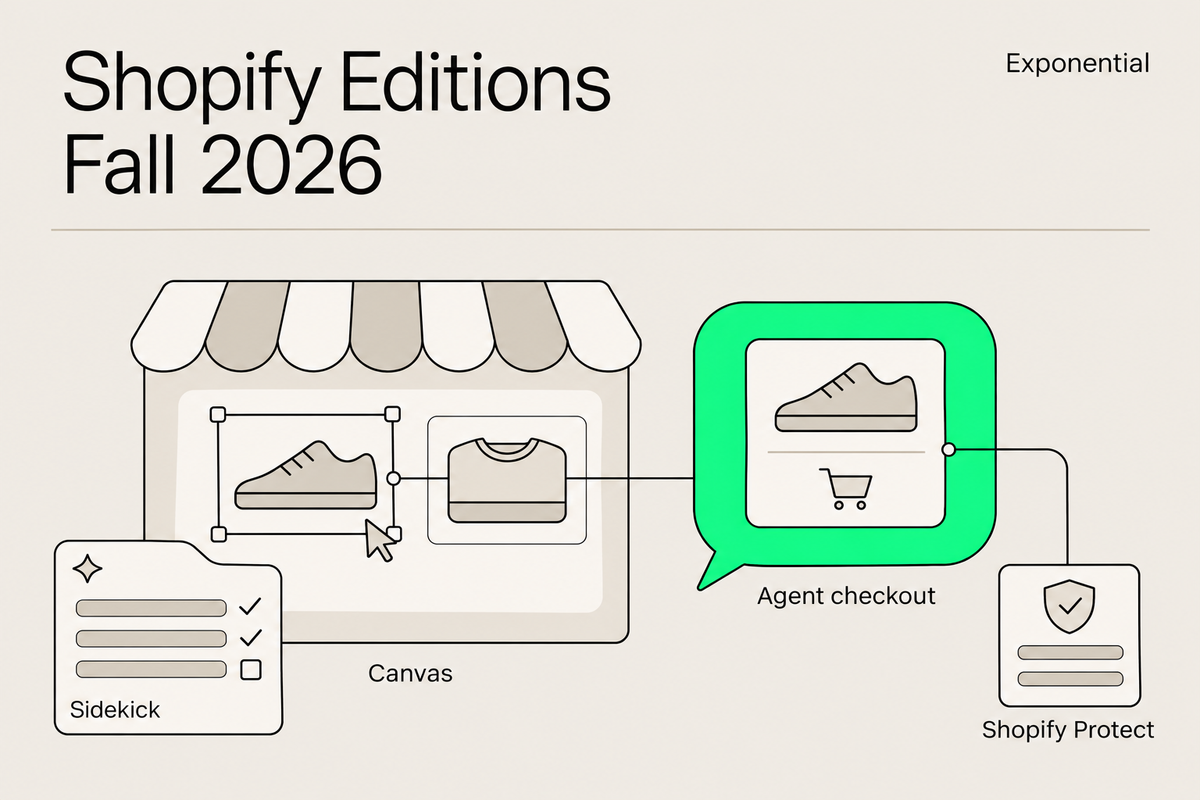
Shopify Editions Fall 2026 (codename Exponential) was released on 28 October 2026 with more than 150 updates. The core: AI agents sell your products in ChatGPT, Gemini and Claude, Sidekick carries out tasks in your admin, Canvas shows your whole store as one design and Shopify Protect tackles fraud. For each part you read what is new and what we think of it.
This is not a rewrite of the press release. For each part we list what Shopify announces, what already works for Belgian stores and what we, as a Shopify agency from Ghent, would do. The smaller changes of each month are in our overview of all Shopify updates. All facts checked in November 2026.
Shopify Editions Fall '26 in 60 seconds
Agentic commerce: shoppers buy through AI agents, with Shop Pay as the payment button.
Sidekick: the AI assistant in your admin calculates, writes code and makes changes in bulk.
Canvas and Rollouts: your whole store as one design, and scheduled launches with automatic rollback.
Shopify Protect: automatic fraud blocking and AI responses to chargebacks.
Native features: Shopify builds what used to be an app, from fraud protection to WhatsApp reminders.
Developers: script tags are going away and access tokens now expire.
Note: many features are early access, still rolling out or US-only for now. The figures in the announcement come from Shopify itself and are not independently measured. Check what you see in your own admin today before you build plans on it.
1. Agentic commerce: selling in ChatGPT, Gemini and Claude
Agentic commerce means an AI agent searches, compares and buys on the shopper's behalf. It is what Shopify bets on most in this Edition.
What's new
Shop.md: a shopping skill that lets ChatGPT or Claude search more than a billion products, check out with Shop Pay and track orders.
Shop Pay works in personal agents such as Muse from Meta, Claude Duet and Instinct. You also sell through Google AI Mode and Gemini.
Catalog eligibility: an admin screen that shows whether your store makes it into Shopify Catalog, with links to what to fix.
A knowledge base (Sales channels > Agentic): Shopify drafts facts such as your return window, shipping countries and gift service. Agents only receive what you publish.
Compare-at prices are now shared with agents.
Connectors for nine agents, including ChatGPT, Claude, Copilot, Gemini and Perplexity, to manage products, inventory and orders from a chat.
Our take
This is real, and the time to start is now. We are also honest about it: on our clients' stores we see almost no orders coming in through an AI agent today. That is no reason to wait. Agents already read your product data, and what they learn about your store today decides what they recommend tomorrow.
Product data and store policies are the new SEO. An agent can only recommend what it can read: material, sizes, delivery time, return terms. Good structured data, complete product fields and clear policies count more than ever. An LLM fills in missing information on its own, and that rarely works in your favour.
Two caveats from other agencies hold up. An order in a chat is not yet a recommendation: according to Flux, brands get a median 1.9% share of AI shopping answers. And an inflated compare-at price now stands out, because agents compare it across stores. That is why we include AI visibility in our SEO work for Shopify stores.
2. Sidekick: from chatbot to colleague
What's new
Sidekick is rebuilt: it calculates, writes code, searches the web and remembers what you teach it.
Plans with several changes that you approve once, even for hundreds of products at a time.
Changes tested first in SimGym, Shopify's simulation with virtual shoppers.
Sidekick customizes checkout and customer accounts and edits draft orders.
A floating chat on every admin page. According to Shopify, daily Sidekick sessions are 4.2 times higher than a year ago.
Our take
Sidekick is handy for questions, analysis and a first version of a Flow. We don't let clients approve bulk changes in one click. A deleted product does not come back, there is no staging environment for your data and the activity log has no undo button.
For bulk work we use the GraphQL Admin API, with an export first, a test on a small selection and someone who checks the result. It is slower than one click. With hundreds of products, experience matters more than speed. Merchants in the Shopify Community also report that Sidekick sometimes makes up IDs and variables. Treat it like a smart intern: useful, as long as someone is watching.
3. Online Store: Canvas, Rollouts and search
What's new
Canvas (early access): your whole store on one canvas, editable with Sidekick and built on your theme's design system. Shopify claims 20% faster launches.
Rollouts: schedule changes to theme, checkout, catalog and discounts as one package, with automatic rollback if it goes wrong.
SimGym tests store goals with simulated shoppers.
A shopping agent in your own storefront and better predictive search. According to Shopify, search drives 8% more add-to-carts.
Sign in with Shop in forms (Shopify Forms, Klaviyo), Translate & Adapt that syncs translations automatically, and storefronts in Arabic, Hebrew and Urdu.
Our take on Canvas
Canvas is a threat to agencies that install a standard theme and swap the logo. For custom work, integrations and stores with their own design, little changes. We probably won't use Canvas on client projects: we work with other tools.
The limits are big. A theme you edit in Canvas no longer receives theme updates, does not support app blocks or app embeds yet and cannot be exported. For a growing store that is lock-in you would rather avoid. Unsure whether to use a theme or your own frontend? Read our comparison of headless Shopify vs Liquid.
Our take on Rollouts
Rollouts is promising. Scheduling your Black Friday launch instead of publishing everything by hand at midnight is what everyone wants. Still, we test it on a small promotion first. Some settings only change the online store, so your ads and product feeds can show a different price than your site. So don't use Rollouts for the first time in the busiest week of the year.
4. Merchandising and product data
Map product data per sales channel, so Google, Meta and agents each get the right fields.
Collections from multiple sources and bulk editing of variants on the product page.
Up to 20 barcodes per variant and better URL-based digital products.
Pricing guidance per market within Shopify Markets.
Our take: less spectacular, but useful. Product data per channel is exactly what agentic commerce needs. Clean up your data now and you win twice: in Google Shopping and in AI channels.
5. Retail and Shopify POS
POS recognizes more in-store customers through the Shopify Payments network. According to Shopify, a known customer has over 60% higher lifetime value.
Pull abandoned online carts into the till, share carts across devices and offer local delivery from POS.
Scheduled stock counts, device management, an activity log per staff member and sales attribution to individual associates.
Our take: pulling online carts into the till looks small. The idea behind it is big: online and offline become one customer. For Belgian stores with a physical shop this is the most interesting POS update. What a till on Shopify costs, you read in our overview of Shopify POS costs in Belgium.
6. Payments, checkout and fraud
Shopify Protect blocks risky payments automatically, explains why an order is risky, writes AI responses to chargebacks and adds carrier proof of delivery. With the Protect Rule Builder you write and test your own rules.
Seven new local payment methods in Shopify Payments: Alipay, WeChat Pay, MB WAY, OXXO, Satispay, Scalapay and GrabPay.
Checkout: custom fields and a tiled layout for payment methods are rolling out. Per-market fees are in early access.
Managed Markets with prices including duties and taxes, and Shop Pay alongside your existing payment provider.
Our take: we switch on Shopify Protect for clients on Shopify Payments, especially before Black Friday. Test custom rules first, though: a hard block on large gift card orders also stops real customers.
For Belgium, what stands out is what's missing. None of the seven new payment methods is Belgian and there is no news on Bancontact or Payconiq. How to activate Bancontact on your Shopify store today, you read in our step-by-step guide. And don't count on custom checkout fields being there before Black Friday.
7. Admin, analytics and Shopify Flow
A refreshed admin with a floating Sidekick (rolling out), passkeys and automatically generated store policies.
Inline metafield editing and folders for your files.
Analytics: app events, your own notes on charts, bot filtering and consent-aware sessions.
Flow: triggers on field changes, permissions to test and turn on workflows, and version history.
Our take: bot filtering is the quiet update to watch. If your session count suddenly drops, the filter is often the cause. Your conversion rate then rises on paper. Note the date so your numbers stay comparable. Version history in Flow fixes an old frustration: rolling back a workflow was not possible until now.
8. Shop and marketing
Universal Checkout: one checkout in the Shop app for products from multiple brands, and shop.com as the web version of Shop.
Campaign Autopilot now also works with Microsoft Advertising, Snapchat and SEO. X Ads follows later.
Shop Campaigns, where you pay per sale, comes to more than 35 new markets, including the EU.
Shopify Messaging: WhatsApp automations such as abandoned cart reminders, and a ready-made Black Friday email series.
Our take: Shop Campaigns is interesting because you only pay when you sell. Test it with a limited budget. A customer who buys through Shop is partly a rented customer, though: check whether they later come back to you directly. If you already use Klaviyo or another email platform, skip Shopify's Black Friday series.
9. Shipping, returns and order editing
Shop Promise badges for delivery and returns, for US stores only for now. Badged products rank higher in Shop and Shopify Catalog.
Carrier expansions such as DHL, UPS and FedEx, plus dimensions per variant and barcode scanning.
Return rules per market and per product.
Discounts on existing orders, subscriptions on draft orders and tax recalculation after an address change.
Our take: return rules per market are handy if you also sell to the Netherlands and France. Shop Promise is not a topic for Belgian stores for now.
10. For developers and app builders: the deadlines
If you build apps or have custom code in your theme, these are the dates that count (checked November 2026).
1 October 2026: apps can no longer create or update script tags. Existing tags still run for now.
2 November 2026: the Global Catalog REST API stops. Move to the new Catalog API.
1 January 2027: public apps must use expiring offline access tokens.
15 January 2027: the Knowledge Base app shuts down. Move your facts to the knowledge base in your admin.
1 March 2027: Shopify stops loading script tags in storefronts. Use app embeds in a theme app extension or web pixels.
Also new: WebMCP tools on every Liquid and Hydrogen storefront so browser agents can search and check out, a rebuilt Hydrogen that is generally available, an app security check in the Shopify CLI, IP restrictions for API calls and a new App Pricing model that replaces the Billing API.
Our take: the end of script tags mainly hits older apps and tracking that still loads through script tags. Find out which apps in your store still use them and ask the vendors about their plans. Shopify monitors usage until January and will reassess then. Don't wait for that.
Native features vs apps: what can go?
Shopify builds more and more itself. We think that's good news: fewer apps means lower costs, a faster store and less that can break.
| Task | New in Shopify | What we do |
|---|---|---|
| Fraud and chargebacks | Shopify Protect | Compare with your current app; often enough with Shopify Payments |
| Store policies | Automatically generated policies | Generate them and have them legally checked |
| Scheduling launches | Rollouts | Test on a small promotion first |
| Extra checkout fields | Custom checkout fields (rolling out) | Switch after Black Friday |
| WhatsApp reminders | Shopify Messaging | Test next to your current flow |
| Translations | Translate & Adapt with automatic sync | Enough for most stores |
| Stock counts | Counts in the admin and in POS | Drop the app if you need no extra features |
Specialist apps still make sense for complex stores. Still, every app you drop is one script less on your page and one invoice less each month.
What's missing for Belgian stores?
E-invoicing. Since 1 January 2026, Peppol e-invoicing is mandatory between Belgian businesses, and Shopify still doesn't solve it natively. We connect Billit for that. How it works, you read in our article on Peppol and e-invoicing with Shopify.
US first. Shop Promise, part of the agentic checkout and several payment features start in the US. Belgian stores get them later, or not at all.
Local payment methods. No news on Bancontact, Payconiq or Wero in Shop Pay or in the new agent checkouts.
That's why we advise checking, per update, what you see in your own admin today, and building your plans on that.
What we learned in the Shopify Community
What merchants and developers report about the new features, summarized in our own words.
Sidekick sometimes makes up IDs. Problem: a merchant gets wrong IDs and Flow logic, sometimes with workflows that loop endlessly. Solution: none yet; others keep generated workflows off until tested. Our take: use Sidekick for a first version, never for the final one. Source: Shopify Community thread (August 2026).
No visibility on orders from ChatGPT. Problem: merchants testing agentic storefronts report no confirmed orders, and Shopify doesn't show ChatGPT as a separate source. Solution: unsolved; the tips are a baseline in your reports and better product data. Our take: that matches what we see, almost no orders. Start with your data. Source: Shopify Community thread (March to August 2026).
Script tags stop on 1 March 2027. Problem: developers ask for a way to switch on app embeds automatically for existing stores. Solution: there isn't one, Shopify will reassess in January. Our take: plan the switch now, app by app. Source: Shopify developer forum thread (August and September 2026).
No undo for product changes. Problem: a merchant wants to restore changed or deleted metafields. Solution: not possible natively; backup apps or the updatedAt field in the API help partly. Our take: exactly why there are no one-click bulk changes without an export first. Source: Shopify Community thread (last reply August 2025).
What to do now: your November checklist
Open Catalog eligibility in your admin and fix what it shows. If you do one thing this month, do this.
Check the facts in your knowledge base and publish them: return window, shipping countries, delivery times.
Fill in your product fields completely: material, sizes, care, barcodes. Check your compare-at prices.
Switch on Shopify Protect if you use Shopify Payments, and test custom rules before you activate them.
Test Rollouts on a small promotion before you schedule Black Friday with it.
List your apps and drop what Shopify now does itself.
Have your developer check which apps still use script tags.
Note in your analytics when bot filtering started, so your numbers stay comparable.
Want to follow the smaller changes too? Read the Shopify updates of October 2026 and our earlier analysis of the Shopify Winter '26 update.
How 6th Man helps
We are a Shopify agency from Ghent. We clean up product data and policies so agents and Google read your store well, we run bulk changes safely through the GraphQL Admin API and we work out which apps can go. Building a new store or getting your current store ready for AI channels? See how we build custom Shopify stores.
What people ask about this.
Shopify Editions is the series of product announcements in which Shopify presents hundreds of updates at once, several times a year. The Fall '26 Edition, called Exponential, was released on 28 October 2026 with more than 150 updates.
The biggest updates are selling through AI agents such as ChatGPT, Gemini and Claude, a rebuilt Sidekick that carries out tasks in your admin, Canvas to edit your whole store as one design, Rollouts to schedule changes with automatic rollback, and Shopify Protect against fraud and chargebacks.
Not all of them. Canvas is in early access, several checkout and admin features are still rolling out and Shop Promise is for US stores only. Check what you see in your own Shopify admin today before you make plans (checked November 2026).
Since 1 October 2026 apps can no longer create or update script tags. From 1 March 2027 Shopify stops loading script tags in your store. Apps that still use them must move to app embeds in a theme app extension or to web pixels. Ask your app vendors about their plans.
Shopify connects stores to ChatGPT, Gemini, Copilot and other AI agents, with Shop Pay as the payment button. Whether it is switched on for your store, you see under sales channels in your admin. Start with the Catalog eligibility check: it shows whether your products make it into Shopify Catalog and what to fix.
We build, migrate and grow Shopify stores.
One team for the build, the move to Shopify and the growth after launch, so nothing gets dropped at a handoff.
Read also

- Shopify
- Platform
Shopify updates October 2026: what's new
Canvas, Rollouts for discounts and catalogs, batch fulfillment, DHL labels in the Netherlands and more: every Shopify update from October 2026, explained.
 Arthur Lauwers
- Platform
- Shopify
10 Things That Surprised Me in Shopify’s Winter '26 Update and What It Means for Your Store
Deep dive into Shopify Winter '26 update: AI, experiments, checkout and catalog changes, plus what they mean for growth, ROAS and ecommerce teams.
Arthur Lauwers
- Platform
- Shopify
Best payment provider for Shopify in Belgium and the Netherlands
Best payment provider for Shopify in Belgium and the Netherlands: Shopify Payments, PayPal, Mollie, Adyen and more, with costs, exceptions and a decision tree.
Arthur Lauwers